

Hello to all my Wonderful World Outside Our Window Subscribers,
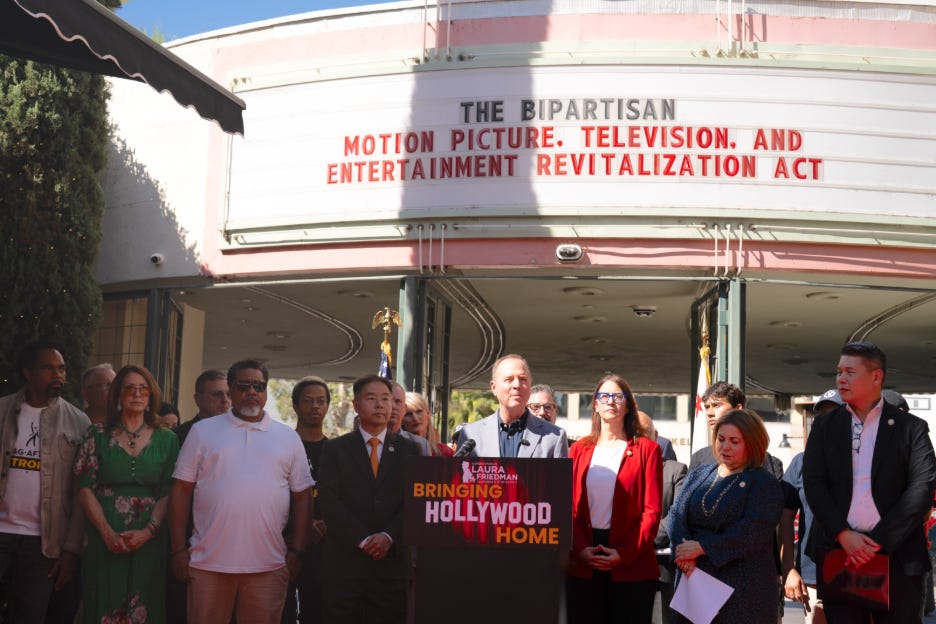
In September, Reps. Nathaniel Moran (R-TX) and Linda Sánchez (D-CA) introduced H.R. 10582 in the House of Representatives. Known as the Motion Picture, Television, and Entertainment Revitalization Act, the bill would create the first-ever federal tax incentives for domestic film and television production. It’s backed in the Senate by Sens. Tim Scott (R-SC) and Adam Schiff (D-CA), and its sponsors hope to attach it to a larger budget bill that the lame-duck Congress already has to pass. Riding an unusual wave of bipartisan support, the bill has President Trump on board, who has long lamented the decline rate of domestic film production, declaring on August 31st that “Hollywood is a Complete and Total Disaster!” and pledging his support for any bill that addresses the issue.
It’s true that production within the United States has fallen off a cliff over the past 25 years, with Variety reporting that “studios spent 74% of their film production budgets in the U.S. 25 years ago, but that the figure has since declined to 42 [while] on the TV side, the figure has fallen from 94% to 64%.” As a semi-professional film critic, I have a vested interest in seeing the American film industry regain its domestic dominance, and I support the bill’s stated goal of reinvigorating what was once a thriving middle-class community. As a full-time member of the Peanut Gallery, however, I think the bill as written has some glaring issues, ones that will undermine any hope of building a more sustainable Hollywood.
The legislation proposes a 20% base credit on qualified compensation (essentially, what a production pays for labor) for film and television productions that cost more than $1,000,000 and shoot at least 75% of their principal photography in the United States. Productions that miss that mark can still qualify through domestic post-production or VFX work. Studios can also stack 5% bonuses, topping out at a 30% credit, for meeting edge cases like filming in a rural area or a disaster zone (thanks to the wildfires, Los Angeles itself is a disaster zone through 2030), shooting across ten or more states, increasing their overall domestic production volume, or qualifying as an “independent” producer. The bill also goes out of its way, by the way, to exclude “blogposts” from the credit, a slight I find both personal and disturbing. Congress is scared of my power, and frankly, they should be.
There is a sense in Washington that the bill must pass before the end of the year, both so productions starting up in 2027 have clarity on their benefits and so Congress doesn’t squander a rare moment of legislative momentum. Even so, Democrats just won a massive victory in midterms defined by economic anxiety and rising anger at the billionaire class. Turning around and immediately offering open-ended tax breaks to some of the biggest corporations in human history would be an unforced error, squandering the potential of a Democratic majority to truly make a difference. My argument isn’t that Congress must wait, but rather the Democrats should use their leverage to make sure it is fixed before it passes. They may not have the majorities in the lame duck, but its obvious they have more power to make demands. Here’s a few that I thought of:
1. Add labor protections. The most glaring issue with the bill as written is its complete lack of them. There’s plenty of precedent for tying tax credits to strict labor standards: the CHIPS Act and the IRA, two of President Biden’s signature achievements, both tied their subsidies to standards like prevailing wages and registered apprenticeships. This bill must include similar guardrails. We can easily make the top 30% tier conditional on paying at least collectively bargained scale (with scaled exemptions for micro-budget indies), and if we’re feeling frisky, tie even the baseline credit to labor standards.
2. Stop exploitative layoffs. The bill also needs to go further to protect the jobs it’s meant to bring back. Former Pixar employees told IGN that animators on 2024’s Inside Out 2 worked seven-day weeks for a month or two to get the film out fast. Weeks before it opened to a record-smashing $150 million debut, Pixar laid off 175 employees. The government can’t be in the business of helping corporations get away with layoffs, especially considering post-production work like VFX or animation counts for a film’s 75-day requirement. When a studio claims this credit, tie it to a clawback provision: if you conduct mass layoffs within a year of claiming taxpayer funds, you forfeit the credit. This bill is about bringing back American jobs, but that only works if we protect them.
3. Cap above-the-line pay. As written, the bill doesn’t limit how much of a star’s pay counts toward the credit. That means when Marvel applies for its credit on the next Avengers film, taxpayers could be covering $15 million or more of Robert Downey Jr.’s reported $75 million salary. Setting aside the fact that films which double as crimes against humanity shouldn’t be eligible for a tax credit (I don’t think this is a controversial viewpoint on the current Marvel Cinematic Universe), the government can’t be in the business of subsidizing vanity paychecks. The bill should cap how much of any one person’s pay counts as qualified compensation, say $500,000. That would also push studios to take chances on newer talent who don’t command such inflated salaries, which goes a long way toward building a more equitable and sustainable Hollywood.
4. Fix the definition of “independent.” In a similar vein, the bill doesn’t do nearly enough for the independent film community. If we really want to increase production in the US, we have to encourage new films, not just the relocation of preexisting productions, and the only way that happens is by helping indie producers, who are driving renewed interest in film among younger generations. The bill defines an independent producer as a company that isn’t publicly traded and isn’t majority-owned by a publicly traded company. That’s idiotic, and it leaves the Treasury open to being robbed by any larger company smart enough to set up a production house it owns only 49% of (or a private VC that is obviously not an indie company). If a publicly traded company owns 25% or more of a studio, its productions should no longer count as indie, and the independent bonus should come with a budget cap of $10 to $15 million to ensure blockbusters don’t sneak through.
5. Lower the minimum budget. The current bill requires a budget of more than $1,000,000. That has to come down to at least $500,000 (ideally $250,000) so micro-indies can reap the benefits. Hits like Obsession or Shiva Baby would be ineligible under the current bill. A well-designed law would deliver proportionally more to indie filmmakers than anyone else, because they’re the people who are truly struggling and the ones who will do the most to help the industry writ large.
Critics will argue that these changes may make the credit less appealing to studios, but I call bullshit. This credit won’t fix runaway production by itself, so it should at least be built to help workers and new films. Runaway production isn’t happening in a vacuum; it’s the direct result of corporate consolidation. When studios merge, they naturally produce fewer movies, creating a bottleneck and giving themselves infinite leverage to demand benefits from any government desperate enough to listen. The American people are tired of being taken for a ride by companies that have been allowed to run free for too long. We shouldn’t be paying a ransom to let a monopolized, fading Hollywood hang on for a few more years. If we’re going to spend public money, we should use it to build a new, sustainable American film industry from the ground up.
Signing off,
Max Bolen
Took one Public Policy Course and dropped it after the first week :)
I never took a Public Policy course, but I rely on the judgment of a very smart friend who said, “Personal impulse makes poor public policy.” It has been a reliable benchmark for many years over many issues.