

Theoretically, we are living through a golden age for the sleepless. We’ve finally traded the circadian tyranny of the 9-to-5 for a “flexible” digital landscape where being a night owl is no longer a curse, but a career path. Between the standardized sedation of the East Coast Liberal — where the nightly SSRI is as foundational as the morning matcha, as routine as brushing your teeth — and our 24/7 digital womb of high-definition distractions and algorithmic comfort, a world meticulously designed to ensure no waking second is ever spent in silence or boredom, the conditions for sleeplessness have never been more hospitable.
By every metric of modern progress, being a lifelong insomniac should be a bespoke luxury — a frictionless glide through a neon-lit utopia of our own making.
Yet, after spending the past ten days falling asleep by 5:00 AM at the earliest, I feel a genuine responsibility — nay, a duty — to report that, despite a powerful PR push, modern society is not all it’s cracked up to be. I couldn’t even find the hit 1976 sitcom Alice streaming anywhere.
The first thing you must learn is patience. We are used to a world of same-day shipping and instant gratification, but sleep is, unfortunately, not a task that can be rushed, optimized, hacked, or even automated. First-time insomniacs often make the mistake of panicking when a restful state hasn’t been reached after forty-five minutes — a canon event worsened, of course, by attention spans that have been whittled down to the eleven-second runtime of a TikTok. The correct response is to lie there. The body will eventually betray you into unconsciousness.
I panic anyway.
After an hour or so of aimless ceiling study, you might try to reset. Doctors — who sleep, we must assume, with the ease and totality of the smugly rested — recommend a walk around your domicile to break the cycle. If your home is an obnoxiously overpriced shoebox chosen voluntarily, despite ample warning, just to be near culture and employment you don’t actually participate in, this walk becomes a two-step shuffle: backward and forward, pacing the length of a rug while trying to imagine a beach. A caring roommate should assume you are in a unique state of mental breakdown that warrants extended study. If they do not, you are simply not pacing hard enough.
During this gait cycle, feel free to put on a podcast, but select carefully. Anything with stakes will destroy you. The recommended options are NPR’s This American Life or Wait, Wait... Don’t Tell Me! Let Peter Sagal’s voice wash over you. Do not actually listen.
By the second hour, the Dopamine Device becomes irresistible. All reason tells you this is paradoxical — like using a hammer to unscrew a nail. But after 2:00 AM, logic is a foreign concept reserved for hours when you are not so exhausted that your vibrational frequency awakens all dogs within a fifty-mile radius.
I have of course reached for the phone every night for the past ten days.
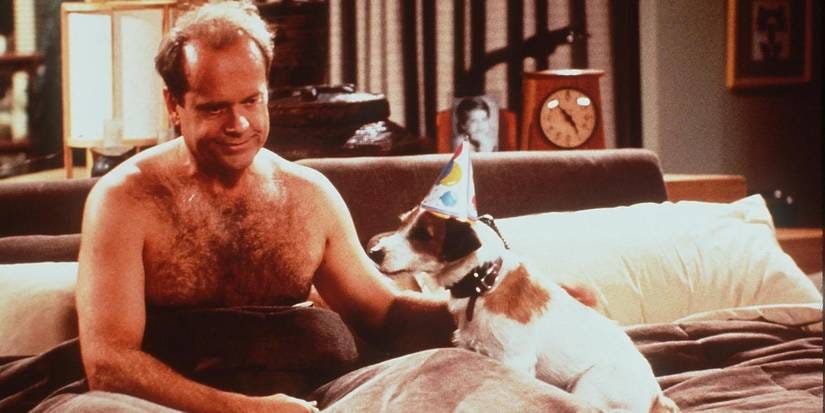
Common wisdom suggests Frasier as the ultimate sedative. Kelsey Grammer’s baritone voice — essentially what a mahogany bookshelf would sound like if it could describe itself — inspires calm, and his character’s stakes, ranging from dinner party seating charts to minor social faux pas, are blissfully low. But as a first-time watcher, I eventually found a doomsday-like feeling emanating from the show’s comfortable world of well-paid intellectuals. Is there even enough liquid capital in the modern world to support that many grand pianos, let alone on a radio host’s salary? Frasier’s apartment — with its fancy chairs and easily hired domestic staff — feels like a taunt. Was I born too late, destined for the permanent underclass, a victim of the coming bifurcation, stuck in the cobalt mines generating power for Mr. Beast’s next video?
An overly pretentious existential crisis regarding late-stage capitalism is not a desirable sleep aid. Let’s try something new.
Enter the FAST apps — Free Ad-Supported Streaming Television, with names like Tubi, FreeVee, or Pluto.
Here, the cable-less insomniac can live out a mid-2000s fever dream, flipping through poorly curated channels cycling through easily licensed political thrillers and network procedurals. Pakula’s All the President’s Men leads directly into some Mark Wahlberg film simply titled Shooter. Reruns of King of Queens give way to episodes of the CBS show Tracker — allegedly one of the most popular shows in America, though the jury is still out on whether the show and its 16 million viewers actually exist.
The FAST apps are a perfect companion for late-night misery: a crude and somehow slower recreation of cable, packaged as innovative technology for unsuspecting twenty-somethings. New movies and shows keep surfacing, all of them somehow five seasons or more, none of them something anyone has heard of. Somewhere in this country there is someone for whom Boston Blue is appointment viewing. They are certainly happier than me, and are probably the true heart of America.
There is no bottom on these apps. At the very least, I have not found it.
By 7:00 AM, you will have finished two three-hour historical epics or a full season of Taxi. The morning shows are beginning. It is time to give up entirely.
The Today Show is the correct choice here — my Good Morning America boycott will continue until George Stephanopoulos is allowed to call as many world leaders adjudicated rapists as he wants. Settle in. You may be reminded, somewhere between the third segment and a cooking demonstration for some soup, that an unpaid intern (working, somehow, on a freelance basis) has an important Zoom meeting today. That intern is you.
It seems that trying to get to sleep in today’s age is just not possible. Better go back to training an AI agent to knock me over the head with a frying pan.
Signing off,
Max Bolen
Actually quite pleasant in real life.