

In 1988, New York real estate mogul Donald Trump bid on a piano that was used in Casablanca. Sitting in the back of the auction room, with a companion beside him to bid, the future President lost out on this prized collector’s item to an anonymous Japanese buyer. Soon after, in an interview with ABC’s Diane Sawyer, Trump declared his love for tariffs, stating his desire to see a “15 or 20 percent tax on anything [foreign countries] sell in the United States,” a sentiment he would keep with him in the decades to come, eventually declaring “tariff” as his favorite word in the English language.
When, in 2015, Trump stepped off the golden escalator in the lobby of his luxury New York City apartment building and announced his intention to run for President of the United States, his platform largely centered around the idea that, for decades, the rest of the world had been ripping the United States off, the United States Government had been ripping you off, and that the neoliberal status quo had to be destroyed by any means necessary. Trump’s visceral anger—fueled by obvious personal grievances and directed at a vague cohort of globalist free traders, government bureaucrats, and the establishment elite—would be enough to catapult him into the Oval Office and fundamentally change the world forever.
The reasons Donald Trump, a (relative) newcomer to politics—previously best known for his reality TV show and many failed businesses—was able to win the presidency will likely be debated and analyzed for decades. But I believe that a keyway to understand how Trump successfully channeled fears and resentments that Americans quickly accepted they had long held is by closely analyzing the film, culture, and, by extension, politics of the late '80s and '90s—leading up to the turn of the century, the Y2K craze, and 9/11. While the period between Clinton’s Third Way revolution in 1992 and the attacks on the World Trade Center is often described as a peaceful, happy, and generally prosperous time for the United States, enjoying its newfound role as the world’s sole superpower, the films of this period tell a very different story. Throughout this period, popular culture increasingly centered on a new kind of American ideal: the lone-wolf hero, a figure who stood outside the system and fought back against corruption, incompetence, and betrayal. They often find themselves trapped in an unfamiliar and dangerous setting, forced to fight tons of villains alone, with little to no help.
This “lone-wolf hero” found its modern blockbuster origins in 1988’s Die Hard, directed by John McTiernan. Initial expectations for the film were low: Bruce Willis was hardly a household name, and the intense violence felt different from the comedic, light-hearted films that had dominated much of the ’80s. Yet, against all odds, Die Hard became a massive success, clearly tapping into something growing in the heart of America, especially through John McClane—Willis’s charming, working-class hero. An NYPD detective trying to save his marriage with his wife, Holly Gennero, after she moved to LA with their kids, leaving him behind in New York City, McClane comes out to visit for the holidays, deciding to show up at her office Christmas party, held in the pristine, high-tech Nakatomi Plaza: the American headquarters of the Japanese Nakatomi Corporation, Holly’s new employer. When German terrorists take over the building, it’s up to McClane to save everyone—and he does it alone, in chaotic and violent fashion.
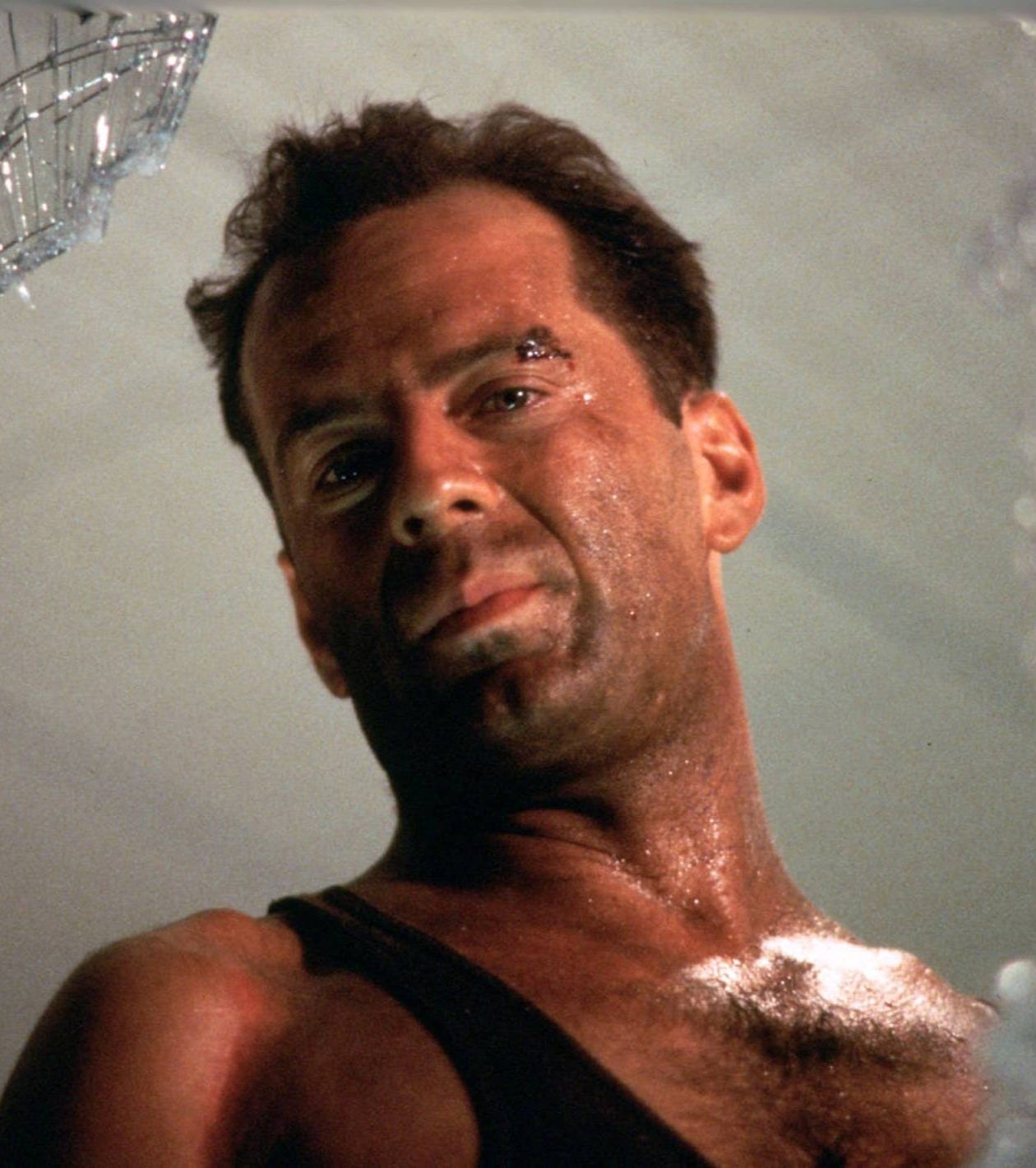
It’s notable that the film goes out of its way to make Willis seem out of his depth when he arrives at the office, like a tourist in a strange land. Action heroes are often shown as being out of place—stuck on an alien planet or lost in the jungle—but in McClane’s case, his place of alienation is just an office building. The unfamiliar, hostile world he’s fighting through is corporate America. Even before the German criminals show up, McClane feels isolated, struggling to survive in a setting where he doesn’t belong. He’s a working-class guy in a world built for wealthy elites. There’s no room for him in this new, increasingly globalized economy.
He watches as the terrorists kill the CEO, who calmly tries to negotiate with them, assuming all they really want is money. He listens as the media picks up the story and spins it into a spectacle, turning the real danger into entertainment. And when the cops finally show up, they open fire at anything that moves, including McClane. This distrust in institutional competence and good faith, so vividly dramatized in Die Hard, would find horrifying real-world echoes in the federal sieges at Ruby Ridge and Waco. In Law and Liberty, Titus Techera describes McClane as a cowboy—a man’s man, a modern-day John Wayne. And the villain isn’t some physically imposing brute, but an intellectual, an academic, who mocks “John the Cowboy” and weaponizes the media, the police, and corporate bureaucracy to his advantage. Gruber is smarter, slicker, and better connected than McClane. So, when he’s finally killed, it’s not just a relief—it’s cathartic. The regular guy wins. The audience wins. The American everyman triumphs over the smug, foreign intellectual. The world is back to where it should be, at least for a moment, with America at the top, and foreign invaders, whether corporate or not, defeated.
Yet, in 1992, Senator Paul Tsongas would famously declare, “The Cold War is over. Japan won.” Speaking to a newfound anxiety that would mostly go ignored, Tsongas was making the point that victory in the Cold War had not solidified American dominance, but rather made clear our decline. We were no longer scared of bombs or nukes, but a new all-consuming fear would grip the nation and add to the alienation felt by the working class: the idea that America was being stripped apart and sold to the highest bidder. Things like the stock market became ever more prominent in American consciousness, with the fate of workers resting on whether the markets rose or fell. Tsongas would not perform well in the Democratic primaries, and his warnings went mostly ignored, the Democratic base preferring the sleek, “Third Way” politics of Bill Clinton.
Young, modern, and charming, Clinton offered an enticing solution: accepting globalization and deregulation while still retaining a socially progressive gleam. Rather than cut welfare, Clinton wanted to reform it; rather than rail against the evils of big business, he wanted to find solutions that benefited both workers and CEOs. This move won the Democrats a Presidential election, but it fed into the pervasive sense that no one in the country was looking out for the little guy. This realignment was felt in pop culture, and the action films of the '90s would make clear the cracks in Clinton’s plan. Corporate villains, government ineptitude, and shadowy special interests became routine antagonists. In films like Enemy of the State (1998) and The Siege (1998), fears about surveillance and government overreach were pushed to the forefront, suggesting that the greatest threats to American freedom might come from its own intelligence agencies. We were no longer fighting the Russians or staving off a foreign conflict; instead, our heroes fought to maintain their own lives. Dads, cops, and even soldiers began to be framed as relics of a past long gone, replaced by new ways of thinking and new technology. In that way, we can see the hyper-masculine action hero of the '90s as a resistance figure, fighting to maintain his place in a world that seems ever intent on leaving him behind, and 1992 as an inflection point, the year where things changed, even if it wasn’t immediately clear how they changed.
Francis Fukuyama famously declared it “The End of History,” stating that from now on, the status quo of liberal democracy would remain static. The Washington Post dubbed it “The Year of the Woman,” and The LA Times called it “The Year of the Angry Voter.” The simplest way to describe 1992, and the subsequent movements that would spawn in its wake, is with one word: weird. As writer John Ganz explains in his book When the Clock Broke, the first year a Democrat won the presidency since Carter in ’76 was also the year that the far-right began to break out into the mainstream of America.
This “New Right,” comprised mostly of “oddballs, cranks, and even crooks,” as Ganz describes them, managed to capture the public’s attention and deliver a worthy challenge to the establishment status quo. In the form of Ross Perot’s failed but impressive third-party campaign, Americans were reminded that the two-party structure was not the only option—and, in many ways, that neither party was fighting for them. In the form of Pat Buchanan’s primetime RNC speech, Americans were introduced to the “culture war” and told there was a “religious war going on… as critical to the kind of nation we shall be as was the Cold War itself,” with Clinton and his support of “abortion on demand” and “homosexual rights” threatening to permanently change “a nation that we still call God’s country.” And in the form of the government’s raid on Ruby Ridge—followed by the shooting of a woman and child by the FBI—Americans began to believe that laws didn’t work to protect them, but rather to protect their oppressors.
While Buchanan’s words at the RNC were mainly dismissed by the GOP establishment (temporarily, at least), and Perot’s new third party lost steam about as quickly as it showed up, the ideas and gripes they introduced into the American discourse would continue to fester—lurking in the backdrop of culture. Beginning in the '90s, a new boom of violent, intense, and politically charged films would begin to dominate the box office. The villains of these films are familiar to anyone who follows modern-day MAGA rhetoric. They often include lazy or incompetent bureaucrats, entrenched special interests, or rogue three-letter agencies. Corrupt politicians—especially Presidents—are everywhere, not to be outdone, however, by the startling number of superhero-like politicians, beloved by all. The news media is often shown as incompetent, too credulous of government lines, or simply interested in profit—not facts. The specter of technology usually lurks in the background, generally in the form of an advanced, non-American-made product.
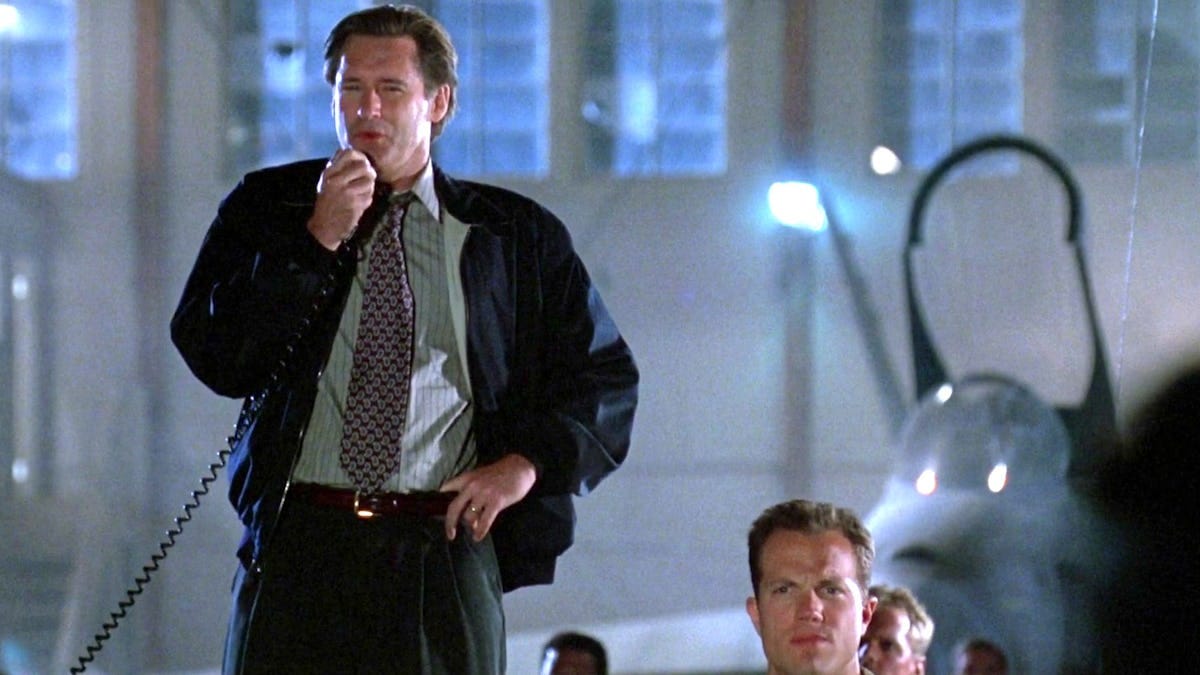
Hollywood, responding to these cultural shifts, would simply redo the Die Hard mold repeatedly. While Bruce Willis may have won the battle in ’88, the war was only just beginning. Films like The Rock (1996), Broken Arrow (1996), and Speed (1994) recycled the "lone hero vs. bureaucratic incompetence" formula, embedding the sense that American institutions could no longer be trusted to protect ordinary citizens. In 1996’s Independence Day, this failing bureaucracy is given the spotlight. Unable to prevent an impending alien invasion, Roland Emmerich’s disaster film shows an extreme version of institutional collapse. The film depicts hapless government scientists, incompetent in the face of a real threat, and flat-out evil intelligence agencies, hiding the truth about aliens and their dangers from the American people until it is too late. The movie also introduces a somewhat new trope, however, with the President taking the form of an action hero, bucking procedure and shrugging off safety concerns as he mans a plane and leads the world in the fight against the alien invaders.
Similarly, in one of the more successful Die Hard riffs, 1997’s Air Force One would put Harrison Ford, as the President, in McClane’s shoes. After taking over the President’s plane, Eastern European “neo-nationalists,” as the film describes them, attempt to hold the President hostage to bargain for the release of an imprisoned Russian general intent on expanding the Russian empire and restarting the Cold War. Little do they know, this President is a soldier, a fighter from an era before politicians were lazy and rich. Ford’s President is clearly an analog for Clinton, an imagined version of the 44th President who is more manly, able-bodied, and tough. At a time of relative peace in the world, Clinton was sometimes portrayed as weak, with people accusing him of having lackluster foreign policy. Ford’s President Marshall also sheds the baggage of Clinton, who at the time of the film’s release was embroiled in multiple scandals over his questionable personal life.
Air Force One is an incredibly interesting artifact, and one of the films from the '90s with the most staying power. The Russian villains are perhaps the most fascinating part, as director Wolfgang Petersen literally forces the old threats to come back, momentarily distracting Americans from their increasingly complex world. Ford is a symbol of nostalgia, harkening back to an imagined past where the President was a force of moral good, a strongman who defeated America’s enemies while flashing a smile and cracking a joke. Yet, as scholar Patricia Ventura points out in her paper “A New Marshall Plan,” Air Force One goes to great lengths to reinforce a globalized neoliberal status quo. President Marshall is not simply defending American soil for its own sake; he is defending a global liberal order against nationalist extremism. In that way, Air Force One lets Americans cling to the fantasy of masculine, unilateral leadership, even as it asks them to accept a world where America's role would be to lead globalization, not retreat from it. The film thus offers a strange contradiction: it satisfies the desire for an old-school hero even as it pushes audiences to accept a new, interconnected world order.
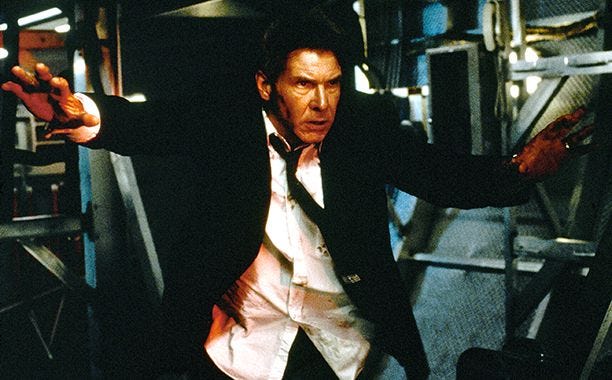
Years later, while running for President in 2016, Donald Trump would talk about Air Force One with some frequency, saying he admired Harrison Ford’s character and the way he “stood up for America.” In fact, Trump used the music from Air Force One so frequently during his 2016 campaign that the film’s producers had to formally ask him to stop. He didn’t, of course, finally using it before he walked onto the stage on election day and delivered his victory speech. It is obvious that Trump sought to co-opt the action hero anti-establishment loner persona which Ford had so iconically defined, speaking to the larger influence these films had on the American psyche.
Trump himself also embodies the contradiction at the core of Air Force One. He runs on an America First platform, raging against the globalist forces who are supposedly ripping America off. Yet, in his own life, he has greatly benefited from free trade, opening hotels in various countries, producing cheap merchandise in overseas factories, and aligning himself with foreign financiers. Trump’s persona echoes the cultural fantasy embedded in '90s action cinema: the lone, heroic figure who rails against elites while simultaneously operating comfortably within elite structures. Like the Presidents and heroes of these films, Trump invites his supporters to believe that strength and rebellion can coexist with privilege and global power.
By the end of the 1990s, lone-wolf hero stories had fully entrenched themselves into American culture. Individual figures succeeded where institutions failed, or where government grew too slow, corrupt, and incompetent to act. They offered simple moral universes where a single person—usually an everyman—was able to rise above and triumph against overwhelming odds. Yet, in many ways, the world they were depicting was already gone, and the idea that a single man could save the day was a comforting fantasy. The Cold War was over, and globalization was rapidly reshaping the world, with China officially joining the WTO at the turn of the century, and, in the realm of film, foreign box-office numbers permanently surpassing domestic profits by the end of the '90s. As the new millennium approached, a new fear emerged: the Y2K bug, a computer glitch that many believed could disrupt everything from airplanes to banking systems.
While the Y2K crisis never materialized, the hysteria surrounding it exposed a deep cultural fear: that American systems were fragile, untrustworthy, and vulnerable to catastrophic failure. This fear mirrored the distrust of institutions that had been growing throughout the '90s, a distrust that action films repeatedly dramatized through lone heroes fighting against massive, indifferent bureaucracies. Soon after, the catastrophe that many Americans had feared arrived, in the form of 9/11. The need for a hero no longer belonged solely to the silver screen.
The War on Terror made real the stakes that '90s action films had so vividly imagined. Wiretapping, overseas black site prisons, endless wars, and creeping authoritarianism became normalized. The lone-wolf action star naturally evolved into the superhero: a figure no longer just saving a building or a family, but the entire planet from invisible, often existential threats. Superheroes, like John McClane before them, operated outside the system, serving as jury, judge, and executioner. The fantasy had simply grown bigger, but its cultural roots remained the same.
This brings us to our present moment, and America’s “new normal.” Trump’s victory in 2016, and his continued political dominance in the decade since, shows how deeply these myths have ingrained themselves into American society. Trump’s persona, like President Marshall’s in Air Force One, allows Americans to see themselves as heroic rebels fighting a corrupt elite. Every time Trump fails, it is not seen as a reflection of his own flaws, but as evidence of the global forces conspiring against him, further reinforcing the myth in the minds of his supporters. In this way, Trump’s victory can be seen not as a rupture or a surprise, but as the culmination of a narrative Americans had been rehearsing for decades—one first set in motion through the action films of the late 1980s and 1990s.
How that story now ends is anyone’s guess, but if our movies are any guide, death, chaos, and destruction are sure to come before any light appears at the end of this very long tunnel.