

Hello to all my Wonderful World Outside Our Window subscribers,
After a nice eight-year break, the Clintons have once again been dominating the news cycle. The former President’s past associations with Jeffrey Epstein — and the quieter, but perhaps better documented, connection to Ghislaine Maxwell — have led many to demand answers from one of America’s most powerful couples. With the Clintons potentially preparing to testify before Congress, my mind has been aflutter with decades of Clinton Conspiracy Theories, taking up valuable brain space that I really should be using for basic life skills, like learning how to dress myself or filing taxes.
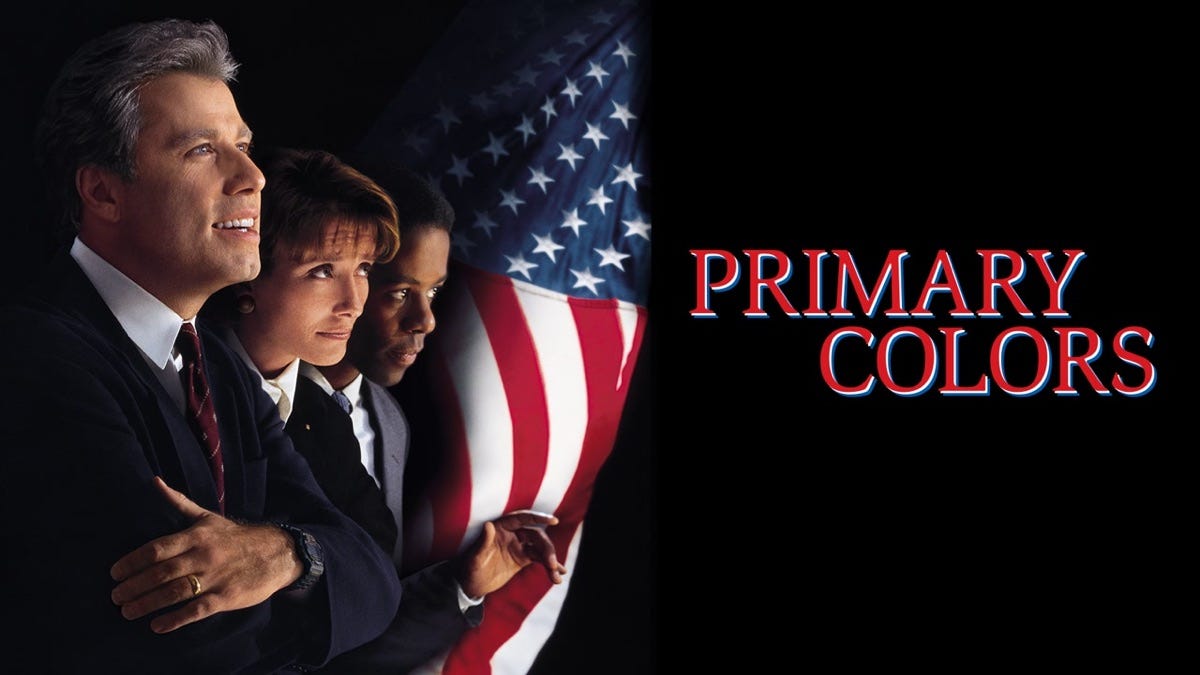
Naturally, this felt like the perfect excuse to revisit a longtime curiosity of mine: 1998’s Primary Colors.
Directed by New Hollywood legend Mike Nichols, with a script from the equally legendary Elaine May, Primary Colors closely tracks the Joe Klein book on which it is based. That is to say it is a thinly veiled retelling of the 1992 Democratic Primary and the numerous trials and tribulations that befell the eventually victorious Clinton Campaign. The book was originally published anonymously before Klein — ever desperate for attention and unburdened by pesky concepts such as journalistic integrity or shame — revealed himself as the author.1 A mix of fact and fiction, Primary Colors is, in its own perverted way, one of the most honest depictions of American politics ever put to screen. It essentially accuses the First Couple of murdering the soul of anyone they speak to, after all.
The film follows Henry Burton (Adrian Lester), the grandson of a Civil Rights icon, who abandons his comfortable Capitol Hill gig to work for Jack Stanton (John Travolta), a smooth-talking Southern governor with a wandering eye and presidential ambitions. Together with Susan Stanton (Emma Thompson) — Jack’s steely, calculating wife — legendary strategist Richard Jemmons (Billy Bob Thornton, really channeling his inner Carville), and Libby Holden (Kathy Bates), a fresh-from-the-psych-ward former chief of staff, this gang of dreamers and degenerates must claw their way to the White House through a minefield of sex scandals and backroom deals.
Released in March of 1998 at the height of the Monica Lewinsky scandal, the film suffered from a cosmically unfortunate coincidence of timing. Although well-received by critics, Primary Colors landed with a thud at the box office. It doesn’t take a genius to understand why Americans, already exhausted by the 24/7 news cycle, were disinterested in a fictional send-up of the very drama they were living through.
It is easy to see how some viewers might have been turned off by the very first scene. It depicts Stanton visiting an Adult Literacy Center in Harlem, regaling the predominantly Black attendees with a story about his Uncle Charlie, a World War II Medal of Honor recipient who was never brave enough to admit he couldn’t read. Nichols shoots the monologue with immense care; the camera circles the wide room, catching the admiring faces of the attendees before slowly moving in on Travolta, whose beaming smile invites everyone to believe — if only for a moment.
Of course, just two scenes later, we learn that “Uncle Charlie” is actually a random campaign assistant far too young to have fought in WWII, and we catch Stanton walking out of a hotel room, barely dressed, with the librarian from the previous scene following behind him, equally naked.
Here, the movie reveals its central tension. Stanton is a man of “harmless” lies or sleazy affairs who presents as authentic and down-to-earth. But as the campaign gains momentum, the compromises shift from personal to political.
This shift is best captured in a scene at a New Hampshire factory. The attendees begin the rally hostile, many of them suffering unemployment due to offshoring. Stanton, looking exhausted and dressed in a large, informal coat, starts off by bluntly telling these laid-off workers that they will not be getting their jobs back. In a friendly yet stern manner, he lectures them on their responsibility to educate themselves and “adapt.” On the sidelines, his aides worry he has lost them. But Stanton, ever the charmer, promises to help them every step of the way, suggesting that as President he would fully fund education for one’s “entire life.” The workers erupt in applause.
It is a masterclass in political theater: he sells them hard, paternal, and explicitly conservative ideas wrapped in a warm fantasy. Yet, the film refuses to acknowledge this ideological pivot. As scholar Myron A. Levine points out, the film glosses over Bill Clinton’s “New Democrat” ideology — with support for the death penalty, or the dismantling of welfare “as we know it” dominating his campaign — instead crediting Stanton’s (and by extension Clinton’s) success to his magical empathy.2 While it is conceivable New Hampshire factory workers are just sincerely conservative, Mike Nichols and Elaine May fans certainly are not — and yet, the allure of Stanton is hard to deny.
This pivot to the “New Democrat” center sets the stage for the film’s true tragedy: the death of Libby Holden.
Libby isn’t just a fixer; she is a relic. A self-described “Dustbuster” who cut her teeth on the 1972 McGovern campaign, she represents the old guard of Johnsonian liberalism — messy, passionate, and fiercely principled. She believes in the cause. But it’s the 90s now, and the party has changed.
In the film’s second half, the Stantons face a threat they cannot charm away: Governor Freddy Picker, a reluctant, honest candidate. To win, the Stantons order Libby to dig up dirt on him. She succeeds, finding evidence of a past drug addiction, but she refuses to use it. She realizes that destroying a good man to elect a flawed one is a bridge too far. The Stantons, however, have no such qualms. They are willing to execute the “New Democrat” strategy: win at any cost.
This betrayal breaks Libby. Realizing she is fighting for a man who has replaced her idealism with ruthless calculation, she takes her own life. With Libby gone, there is no one left to say “no.” The old party is dead.
This brings us to the film’s haunting final shot at the Inaugural Ball. Henry Burton, who knows everything — the lies, the affairs, and the cost of Libby’s life —takes President Stanton’s hand. Is he still working for him, after vowing to quit? Nichols leaves that ambiguous.
At the time, that ending played like a question about political compromise. Was it worth ignoring Clinton’s flaws to get him The White House? A CNN poll released on the day of the film release (March 20th, 1998) seemed to suggest, for most of the country, it was: while 52% of Americans believed Clinton had participated in a pattern of sexual misconduct, only 32% of those polled thought he should be impeached. His worst crime? Lying under oath, with 74% of Americans thinking it was much worse than any potential harassment.3
But looking back now, with the Epstein files spilling open, the scene plays almost like an indictment. Primary Colors captures the exact moment the deal was struck. Clinton’s charm didn’t just cover up a few affairs, it opened up the door into total moral collapse, bringing the whole American political system down with it. The road that starts with “harmless” lies or alleged affairs and ends on a private plane with Jeffrey Epstein or Donald Trump as President is paved with handshakes just like Henry’s. He freezes his smile, pretending the hand he’s holding isn’t dirty. All the audience can do is pretend they aren’t either.
Signing off,
Max Bolen
Wishing you and yours a very lovely President Day :).
For those curious, Joe Klein is now a fellow Substacker and last made news after he was one of Andrew Cuomo’s “highest profile” endorsers in the mayoral race. The 90s, it seems, didn’t end for everyone.
From Levine's fantastic essay in the stellar book Hollywood's White House: The American Presidency in Film and History, which can be purchased here: https://www.thriftbooks.com/w/hollywoods-white-house-the-american-presidency-in-film-and-history/854540/
I gotta see this one