

Warning: There will be many spoilers in this essay. Please, feel free to read it later if you have not gotten the chance to see the film yet!
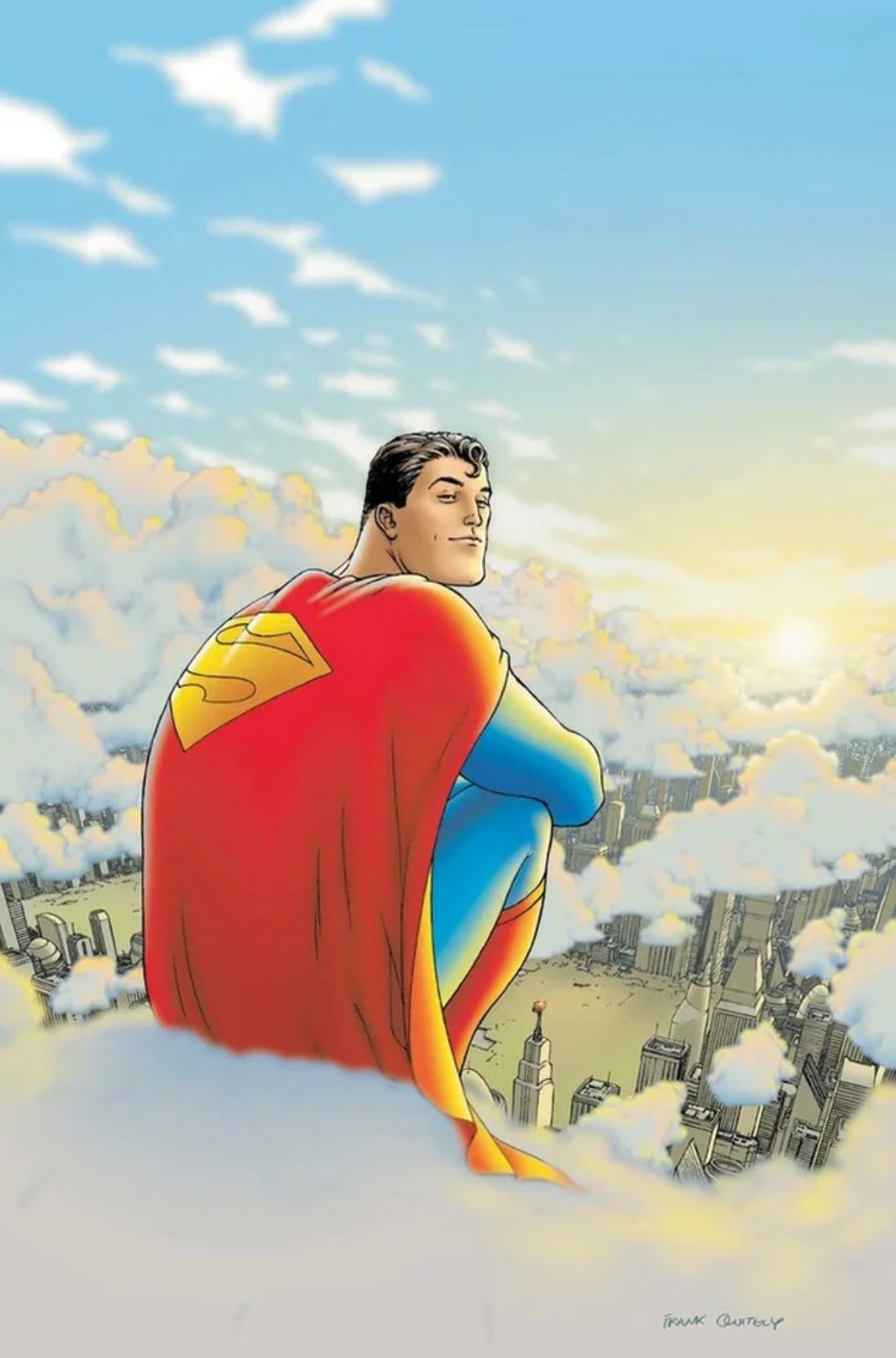
Last week I took a trip to the theater and visited my good friend Superman. It had been a while since I saw him on the big screen, and despite my intense cynicism towards superhero films, I got tickets for opening night and went in with a (mostly) open mind. I’m happy to report that, almost in spite of myself, I had a very fun time. I got a large soda, ate an entire popcorn bucket (that was my dinner), and clapped with the rest of the audience when the credits rolled.1 Yet, although I had a fantastic time at the movies, I think that Superman is fundamentally flawed in a lot of ways which hold it back from being truly great.
Superman is a movie that is at war with itself. James Gunn, in his role as writer/director, clearly wanted to make a silver/golden-age throwback to the goofy and earnest side of the character which is rarely shown on screen. But, at the same time, President of DC Studios James Gunn had to set up an entire expanded universe that is enticing enough to fans that he can get the green light from a notoriously cheap Studio Head to go ahead and build a multi-billionaire dollar franchise with basically the fate of a storied and historic movie studio on his back. Easy stuff.2 Going into the film, I knew I would like it if writer/director Gunn was able to shine through, and the parts which are just that really work, with some moments when I truly felt like I was watching the Superman movie of my dreams. Unfortunately for us, most of the film is clearly made by President of DC Studios James Gunn.
I do obviously see how in hindsight this is not surprising, but come on, it's Superman. I had hope.
Let's start with the good. The aesthetics of the world scream classic comic book, from the monster design, to the costumes, and even the interior of the Fortress of Solitude, with its talking robots in tow. Gunn successfully transports the bright, wacky, colorful world of Superman into modern times, while still maintaining the edge that made films like Guardians of the Galaxy such a blast. I was impressed with the opening scene in the Fortress of Solitude, and the way Superman's robots spoke with such a modern, snarky attitude while still feeling silly and earnest. The dialogue in old comics is part of why their fantastical elements work and never seem out of place. All the classic comic characters are dramatic and over the top which helps to sell the absurdity of their situation, but a quirk of modern superhero films is that, in some way, shape, or form, the dialogue is always going to sound like a Joss Whedon movie, with his quick comebacks, sarcastic asides, and just stubbornly modern feel. This helps to ground movies, and make the characters feel more relatable — hence why it mostly works for the MCU — but it can make some of the more goofy parts of a comic book flick feel out of place.3 Luckily, I thought Gunn did a great job keeping the jokes and edge which modern audiences expect, while still instilling the characters with a sense of heart and sincerity. The robots play Superman's parents' message to help soothe him as he heals, while at the same time complaining about their lack of a name. It's fun stuff.
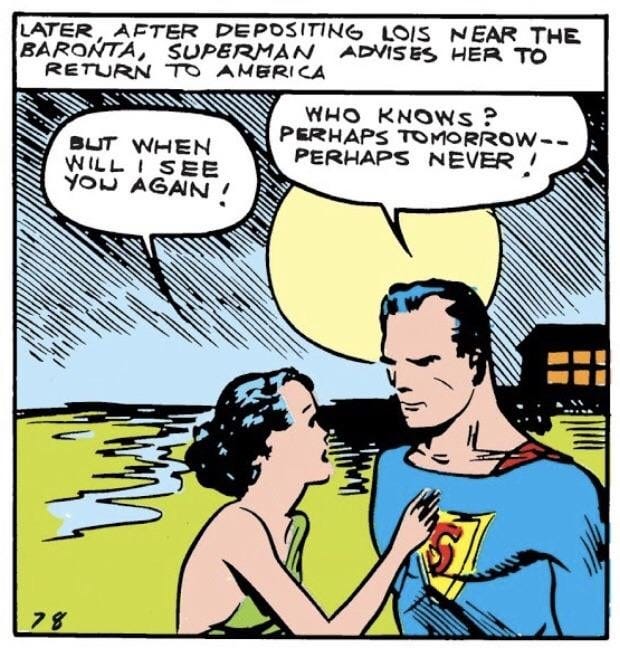
The casting is brilliant, especially The Daily Planet characters. While I think that David Corenswet is mostly just fine as Superman, whenever he is on screen with Rachel Brosnahan's Lois Lane, the film just shines. Their chemistry is off-the-charts, and their (criminally brief) conversations are so snappy and authentic, I really just wanted to watch a movie about their day to day life. Skyler Gaisano is incredible as Jimmy Olsen, and I really appreciated how there is like a 5 minute side plot where he goes to a dark alley to get information from a mysterious source, and Gunn shoots it like a noir film, a dark night in a dingy Red-Lights-type district of Metropolis, the bare cobblestone the only thing in Jimmy’s path until he is suddenly pulled behind an alley…only for us to learn his “source” is Lex’s girlfriend who is, naturally, deeply in love with Jimmy.4 Beck Bennet plays a hilarious Steve Lombard, a minor character from the comics who edits the Sports Section, and there’s a moment when Wendell Pierce’s Perry White is smoking a cigar and screaming “Don’t call me chief!” which just made me smile so wide.
The structure of the film is also a bit wacky, but once I adjusted to it, I appreciated the way it felt episodic, like reading seven issues of a comic. The movie just drops you into the story, and while I have my qualms with the lack of an origin story, I do appreciate the attempt to replicate the feeling of picking up a random comic and figuring out the background details. This is the way in which the film feels most like a comic book, something I always claimed to want out of superhero films, but now that I’ve gotten it, am skeptical. The structure is really where my love for this film ends and turns into a confused distaste for its many flaws. I believe that the choice to cut out the origin story really undercuts the nature of Superman as a character, making it quite difficult for the film to sell its themes. Just like when the MCU cut out the Uncle Ben origin and Tom Holland’s Spider-Man felt directionless, with no sense of responsibility or purpose, by choosing to not show the origin and only including a brief message from Kal-El's parents, I think it can be hard to buy Superman's motivation and reason for being.
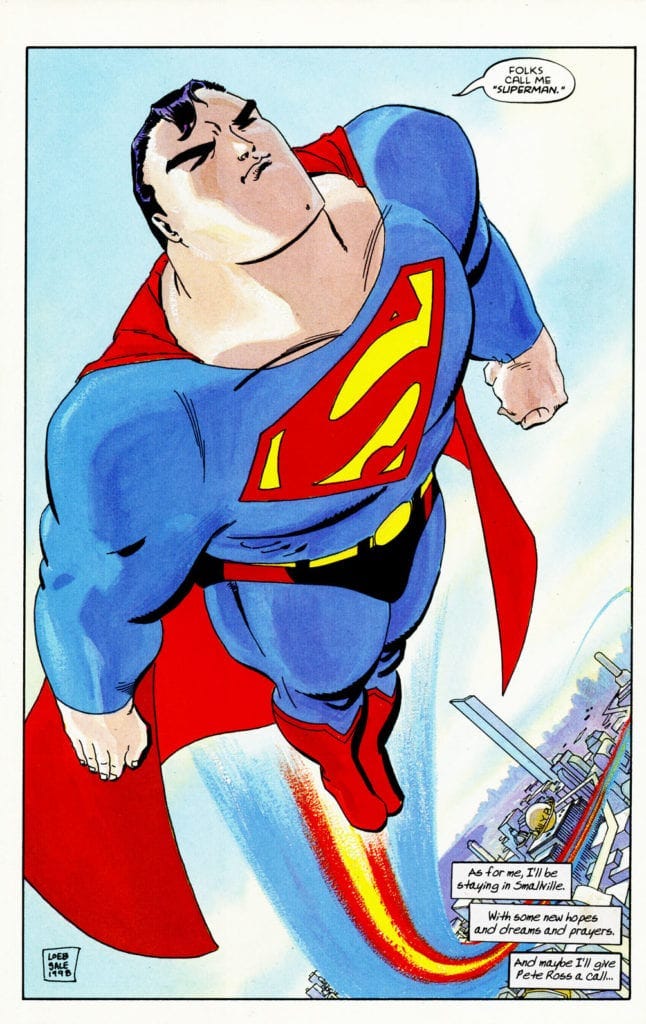
While I acknowledge (and don’t care) that Gunn changes the story a bit in this one — Superman’s birth parents end up being evil — I think even a short sequence at the beginning of Clark growing up in Smallville and being raised by the Kents would’ve made his character feel more well-rounded and developed. Gunn wants us to believe he has been doing this for three years, but also doesn’t really tell us why he started, or give us any context about his life. It’s not till late in the film when we finally visit Smallville, and Gunn gives us a very short sequence which needs to do a lot of work to sell the final act and Superman’s big, climactic, theme-summarizing speech. It just about barely succeeds, but I question why we didn’t have an opening which could’ve done something similar, in a more thoughtful way. There’s a short scene of Clark speaking to Pa Kent on the porch, which is enough to sell the humanity/kindness angle but really should’ve been expanded to make the whole thing feel more sincere. Gunn is constantly mimicking sincerity, not actually delivering it.
In that vein, the whole second act is a complete mess, as Gunn sets to work setting up an entire cinematic universe in which Superman is only a small part. After Superman is captured by Lex, the film goes on a long detour where Lois Lane visits the Hall of Justice and recruits the help of Mister Terrific. I have no idea why Mister Terrific, a B-tier character from the comics, is in so much of this film. He takes up an inordinate amount of screen time, and while he is certainly a cool character played very well by Edi Gathegi, he is in fact not Superman and not who I came to see. There is almost more screen time of Lois and Mr. Terrific than Lois and Superman. Jimmy never even interacts with Superman, who is of course his best pal! There is only one scene in the film where Lois gets a close-up look at superheroics in action, and she is watching Mr. Terrific, not Clark. It is one of the most bizarre choices this film makes, and it genuinely makes the entire experience worse. All the scenes with him, Guy Gardner, or Hawkgirl, are tedious exercises in franchise building, and totally tone-deaf about why people were excited for this movie: they wanted to see Superman…not Gunn’s bargain bin of lovable miscreants.5
The inclusion of other heroes truly works against the film, its themes, and any attempt to make Superman into an enduring symbol of hope. This failure is laid bare in the final act, where Gunn decides to pull the classic “hero needs to be in two places at once” gambit, and rather than finding a way to make Superman, be, well, super, and save everyone, he takes the easy way out and sends the Justice Gang. This is especially lame considering the battle the Justice Gang are sent to was the set-up for the whole film and Superman’s internal conflict. The film starts with text telling us that Clark recently stopped the larger country of Boravia from invading the smaller country of Jarhanpur because, as he says, “people were going to get killed.”6 This sets up an interesting question: what is the role of Superman in an ever-changing, deeply connected, complex modern world? Does he do the right thing every time, simply because it is the right thing to do, or does he pick his battles to avoid controversy and keep everybody happy?
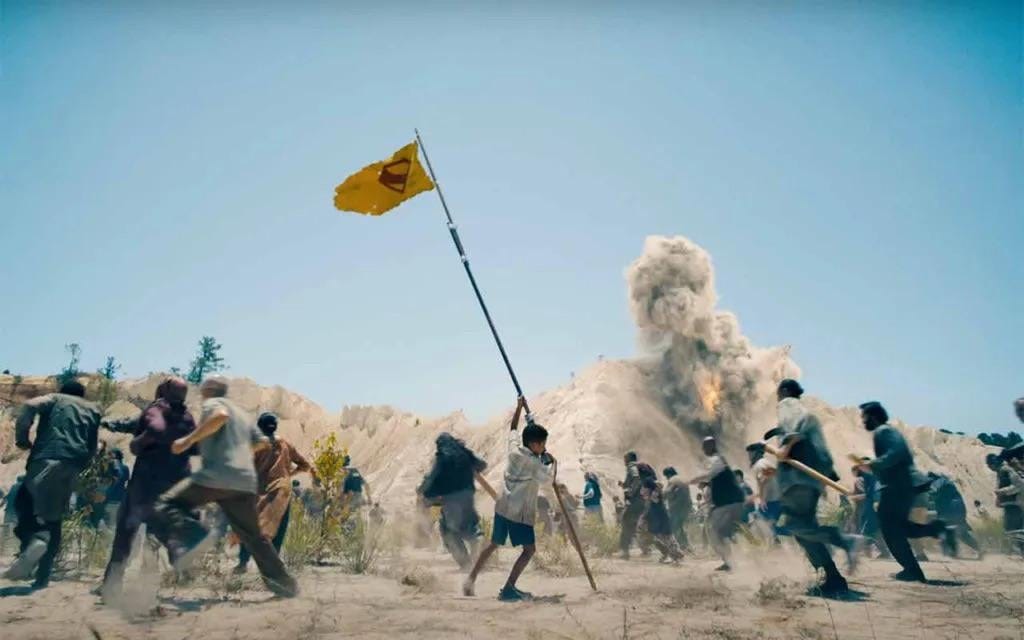
When it seemed like this would be the central idea of the movie, I was all in, and so I can’t express how disappointing it was to see the Justice Gang be the ones who save Jarhanpur, especially considering the sequence is set up with a poignant scene of a child waving a Superman flag, chanting his name. The Justice Gang is also said to be some sort of a corporate, for-profit superhero team, which also naturally makes any themes really muddled and pointless.
While we are on the topic of the Boravian Conflict, this is as good a time as any to delve into the “politics” of Superman, which has taken up almost all of the discourse online and in the media. It goes without saying that Superman is a political entity, whose existence is deeply tied up in Depression-era woes and the American immigrant experience. I personally think of Superman, in his original appearances, as a radical force fighting against the perceived corruption and injustices of rapidly modernizing America, often portraying himself as a friend of the working man and an enemy of rapid innovation. But, the most impactful Superman stories don’t bother making him a one-to-one reflection of a current event, rather they question the nature of power, goodness, and humanity. These are political ideas, and the film has them in spades, but for some reason, everyone just wants to talk about whether or not Superman supports their exact politics.
The overarching response online has been to deem the film firmly “anti-Israel,” an interpretation that, while not meritless, betrays any attempt to not only engage with the film but also the actual real world conflict in the Middle East. There are long standing ideologies at play in Israel’s ongoing occupation, and to flatten it all down to “big country with guns picking on the little guys” is simply an unserious position, and one the film just does not lend itself to anyways.
There are no details presented to us which make Boravia a clear stand-in for Israel, and in fact, all the Boravians speak with a very obvious Russian accent, and what little we see of the country is clearly meant to remind the viewer of Eastern Europe. Gunn has been coy in interviews, likely because he is shocked that anyone is asking him about the Middle East during his Superman press tour and he knows there is no right answer, but it seems clear to me he was thinking about Russia/Ukraine when he wrote the script back in 2022. This is not to say the movie is clearly talking about Russia either, because it also isn’t; it is simply about a larger country invading a smaller country, and killing innocents in the process.
This is a tale that is quite literally as old as time, and the theme — innocents dying is bad — has been a core idea since we started telling stories. It is a story about power, who has it, and how we wield it. I do think, however, that the collective mass-psychosis that has led to a large percentage of the internet declaring Superman a revolutionary anti-Zionist picture is not only fascinating, but gives us an interesting insight into my final point in this essay: I do not think, in the current world we live in, it is actually possible to make a great Superman movie.
America, unfortunately, is probably too dumb and hateful to accept a film that is just about someone’s earnest desire to do good. We live in possibly the most polarized times in our country’s history, and every single piece of art, every statement from a public figure, really, anything, is seen though the lens of partisan politics and sectarian battles. Would Superman have voted for Kamala? Is Lois Lane a liberal? Does the Warner Bros. Company want us to have mass immigration? All of these questions are patently useless, unproductive, and dead ends, but it is all anyone seems to want to engage with these days. There is no more appreciation for the inherent artistry in a film, for the beauty and joy of a simple metaphor. Now everything needs to be a direct statement delivered straight to the camera, or people just go insane with overreactions and huge leaps in understanding.
This concept as a whole is downstream from the reason why, even if Gunn really, really, really wanted to, he probably would never have been able to just make a simple Superman film. The modern American economy — be it the attention economy, the Hollywood economy, etc. — has no room for small stories, and no appetite for one-and-done films. Everything needs to have lore now, every single detail must be colored in or it will be ripped apart online. This movie goes to great lengths to tell us that all the citizens of Metropolis have been evacuated so no one got hurt in the big final battle. Like seriously, it won’t stop mentioning that. The idea that audiences need someone telling them this or they just won’t be able to get past their skepticism that no one died is absurd; this is a movie about a flying alien, I really do not care if it is unrealistic that he saves everyone. People often talk about the media literary crisis sweeping this nation, and I don’t think its ever been clearer then hoards of people making Superman a part of their ongoing political internet battles.7
There's a small moment in the film that I think really sums up my core problem with James Gunn’s new iteration. After Superman is captured, Lois Lane seeks assistance from Guy Gardner, Hawkgirl, and Mr. Terrific. During their initial encounter, Guy reveals how Clark Kent maintains his secret identity: through hypno-glasses that confuse anyone who looks at him, preventing them from associating his face with Superman’s. While the scene is primarily played for laughs8—and Nathan Fillion’s performance is undeniably hilarious—this small piece of lore highlights a fundamental flaw in The Man of Steel’s latest cinematic outing. Gunn appears hesitant to let Superman's inherent earnestness and simple charm stand on its own. Instead, he constantly tries to address perceived "plot holes," offering annoying, in-universe explanations.
The fact is, people don't deduce Clark Kent's identity because they don't want to. The citizens of Metropolis believe in Superman—they trust he is always present, always vigilant, always ready—and in that belief, they simply don't question what he does in his off-hours. The key to any great Superman movie is making the audience also believe, that maybe, just maybe, someone as good as Superman does exist. That, to poorly quote Superman Scholar/Writer Grant Morrison, sometimes an idea is just so good, so pure and full of love, that it might in fact come true. Unfortunately, Superman is unable to make us believe that a man can fly.
It does come pretty damn close, though.
I did leave right as the credits rolled though and the entire theater stayed seated and stared at me. I did not know that end-credits scenes were a thing we were still doing in the year of our Lord 2025. Even at its peak my understanding was that it was just Marvel who did it anyways? I didn’t stay for Thunderbolts'* end credits either but neither did anyone else so I assume it just didn’t have any. Will not be looking into it any further.
I am confident I could do this, Zaslav just call me. It's a one- to two-day project. Three at most.
This is why I do not like the first Dr. Strange. In Dr. Strange, a doctor discovers there is magic after almost dying and he almost immediately becomes a wizard. But the whole movie he is just like, a little hostile and vaguely annoyed at the idea, not really a lot of emotion. There’s a joke about Wi-Fi at the ancient hidden magic palace you get to by doing seemingly the same journey Christian Bale did in Batman Begins. Not into it!
People need to read Jimmy Olsen comics. Darkseid was first introduced in a Jimmy Olsen comic. Jimmy dates a Gorilla in one of them.
Not sure anyone really understands why Guardians hit so hard when it came out. Studios seems to think it has more to do with the fact that the characters were weird, mean, and silly looking, when it is obviously the fact that movie was just plain good, had heart, and was well made. Adding random side characters because they are edgy and funny is not really a winning formula if they don’t contribute to the film as a whole (See: The Deadpool movies, Thunderbolts*, etc.)
This line is delivered perfectly and it comes during the Lois/Clark interview scene, the high point of the film. I wish Gunn actually followed up on these ideas :(.
I do of course realize I am also doing this but that is not relevant because I am Correct and Based.
Although a quick Google search reveals that James Gunn did not mean for it to be a joke and he genuinely could not get past this “plot hole” without an in-universe explanation.
Definitely a lot to unpack here! I do think one of the most interesting parts of the film is, as you've noted, the conspicuous lack of Superman in several important scenes. The aforementioned trailer shot with the child raising a Superman flag, the fight scene watched by a captivated Lois Lane, and even the killing of President Ghurkos are certainly fun to watch, but have forgotten to include the hero of the film. The former is explained by Superman being needed elsewhere - but he's /Superman/! While he inspires hope from the people he protects and has his limitations, he is - in this viewer's eyes - expected to be able to make it all work out without being forced to rely on side characters making their live-action film debut.