

Last week, Letterboxd users were greeted with a bizarre trend on their home screens: thousands of users were logging, rating, and in some cases reviewing the new 30-minute presentation that Rockstar Games made for GTA VI. Within days, it quickly became the highest-rated “film” of 2026, and one of the most watched. Despite being a glorified commercial for a video game, Letterboxd was treating it as a movie, and a good one at that. After meticulously unfollowing any of my so-called friends who had logged the advertisement, I got to work investigating how exactly this even happened.
The answer is frustratingly simple: Letterboxd doesn't maintain its own film database. It farms that out to the publicly available TMDB (The Movie Database). TMDB, the self-appointed arbiter of cinema, decided that because the GTA presentation streamed on Netflix, was self-contained, and felt like an “important” media event, it counted as a movie. Accountable to absolutely no one, TMDB’s moderators are predictably prickly and uncommunicative—the natural byproduct of people who obsess over data entry and internet forums. (Not exactly a recipe for a sparkling personality; trust me, I would know.) Multiple appeals to remove GTA VI have been unceremoniously shut down. There is no recourse. GTA VI is just a film now, I guess.
While it may be silly to care what these websites deem is and isn’t a movie, Letterboxd and sites like it are the lifeblood of indie filmmakers. In an increasingly changing (consolidating) industry, getting eyes on your work is harder than ever, and independent artists have long relied on the internet to promote their work. Letterboxd serves not just as a platform to log films, but as a site to discover them, with their list-making feature, in-depth ratings and reviews system, and easy cross-posting mechanisms allowing people to discover and share new movies faster than ever. But what if TMDB, a site that Letterboxd never overrules, decides that your movie… isn’t a movie?
This is a fairly common story, and one that feels increasingly relevant as Hollywood turns to embrace online filmmakers. For years, TMDB has been quite strict about not allowing “amateur” content on their site, which they describe as anything that premiered or is hosted on a user-generated site like YouTube. Since the GTA VI trailer was on Netflix, and it has the veneer of prestige, it stays up. Your student film that you poured your heart and soul into? Well, that simply doesn’t count.
In order to learn more about this issue, I spoke to filmmaker Christopher Jason Bell, who has been making films for over twenty years. Bell is the very definition of an indie filmmaker: everything he makes is self-funded, self-distributed, self-promoted. He got into it the way a lot of people his age did, wanting a video camera as a kid in the early 2000s, finally getting access to one through a friend in junior high, and treating Jackass and Kids in the Hall as film school.
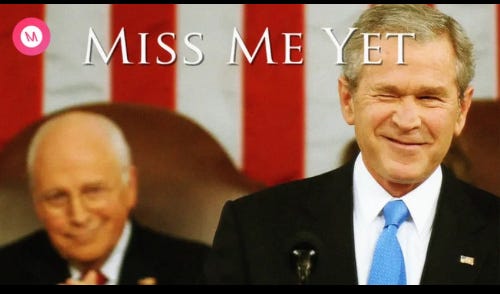
In college he made shorts with his roommates; after graduating, he kept doing the same thing out of necessity, finding collaborators and opening the process up beyond, in his words, “20-some white boys in Brooklyn.” For years it was just him on sound and one friend on camera, which kept costs low enough that he could fund everything himself. He lived with his in-laws for a stretch to save money—an arrangement that, he told me plainly, contributed to a slight mental breakdown—and then COVID hit, and not being able to go anywhere or spend money became, perversely, another way to save up for the next project. More recently he’s shifted toward archival footage, which lets him make films with almost no production budget at all. That’s how he made Miss Me Yet, his documentary assembled from footage of the Bush presidency.
Miss Me Yet is a genuine masterpiece, weaving together eight years of seemingly unrelated clips to tell a complete cultural and political history of the Bush era. It had been on TMDB, and by extension Letterboxd, for years, and racked up thousands of fans along with hundreds of serious, engaged, and thoughtful reviews. A month ago, Miss Me Yet disappeared from Letterboxd without a trace.
Bell claims that TMDB had informed him earlier this year that due to changes in their rules, Miss Me Yet, Attention Shoppers, and one of his earlier experimental works would be removed from the site. He was understandably upset—“it’s my filmography”—and reached out to the moderators in a professional and “not mean” way, hoping to see the issue resolved. They never responded, but Bell moved on, seeing as the film was, at that point, still on Letterboxd, which is what really matters. When he was informed by a friend that it was now gone from Letterboxd, Bell didn’t know what to do. He reached out to Letterboxd directly, and received a fairly ridiculous response about not allowing films on user-generated video websites such as YouTube to be on Letterboxd.
This is confusing for multiple reasons, primarily that Miss Me Yet is not on YouTube, but rather a streaming site called Means.TV, which hosts left-leaning independent film and TV. There is, in essence, no discernible difference between Means.TV and any other streamer beyond the fact that Means.TV is worker-owned, and corporate-sponsor-free. Letterboxd also features plenty of work hosted on YouTube, and has an entire rental service for undistributed movies, meaningly they clearly acknowledge there is great work just waiting to be seen.
After a few rounds of back and forth, Letterboxd said they would reach out to TMDB directly, and Bell hasn’t heard anything since. Each day that passes is another day that someone who may have discovered his work isn’t, and more broadly, that a dedicated, passionate, and deeply talented director like Christopher is being told by a faceless committee that his work just doesn’t count. It would be one thing if the TMDB/Letterboxd regime was consistent, but they unfortunately are not. Connor O’Malley YouTube videos regularly get put on Letterboxd, and things like Kane Parsons’s original Backrooms series get their own pages. Documentarian Jon Bois, whose work has screened in theaters and is widely respected, is consistently taken off the site, and longtime online filmmaker Joel Haver, whose short films get millions of views on the regular, has long been blacklisted from TMDB—they seemingly just don’t like him.
As you may have seen, Letterboxd is currently in the early stages of being sold to a larger company, likely one of the big studios. While they started as a very small website that simply couldn’t afford to host their database, they are now an international media powerhouse that frequently drives discourse in Hollywood. They can and should build their own database, but they won’t, because it would be too much work. And even if they did, what’s to stop their future owners—let’s say Netflix, just for fun—from deciding that competitor Disney no longer makes “real” movies?
Zooming out, a fairly common pattern becomes clear. Hollywood decides to open their gates a little bit and let in creators, but only on their terms. YouTubers may get a small studio deal, and a TikTok comedian will show up in a movie now and then, but Hollywood isn’t ready to actually let creators run the show, or define themselves outside of the Hollywood standard. You can be let in once you become profitable enough, prestigious enough, or in some way legible to whatever gatekeeping apparatus decides you are worth taking a risk on, but if you don’t clear this incredibly arbitrary bar, your work may as well not exist. Christopher Bell has been making serious films for twenty years, but a company that won’t even respond to his emails has decided that just doesn’t matter. GTA VI drives traffic, though, so it can stay up.
This is not just a story about movies, but rather an increasingly restrictive internet. What started as a revolution for free expression has devolved into a handful of private companies pretending to be pro-people. TMDB is not just a neutral recordkeeping company, they are an active part of a long-con to convince consumers that art not made by approved institutions doesn’t really count, and whoever is the richest—or the best at making noise—is what matters. The internet was supposed to break down these walls, but instead it just built newer, less accountable ones.
Bell’s films aren’t gone, they remain important works of art that mean the world to their creator and his many, many fans, but they are invisible to the masses. Towards the end of our conversation, I asked Bell a bit of a broad question: What even is a movie anyways?
“It’s whatever the profit motive dictates it is,” he answered, without a second thought.
A bleak response, perhaps, but an indisputable one.
Signing off,
Max Bolen
Was similarly rejected by industry gatekeepers at the New York Film Festival Press Accreditation Committee (no harm, no foul, I love you NYFF)
You can find Christopher Jason Bell’s films on Means.TV, which offers a free 7-day trial. Miss Me Yet is streaming for free, no account needed. And his newest movie Failed State, just preimed on the site, and is (in this critics opinon) the first movie to actually deal with COVID.
P.S. Ted Hope and the fine people at FilmStack Daily Digest are crowdfunding a buyout of Letterboxd to beat the studios to the punch. Support them here!
I think about this a lot in terms of logging comedy specials. A lot of POC comedians are unable to be logged in Letterboxd, while many white contemporaries are, despite being released on the same streaming platforms. It's very lame
JUSTICE FOR CHRIS BELL.
Letterboxd owes my man an apology.