


Hello to all my Wonderful World Outside Our Window Subscribers,
On June 12th, less than a month from today, a new, wholly original Steven Spielberg Sci-Fi film will be released in theaters. The last time this happened was over two decades ago, so suffice it to say the anticipation for the upcoming Disclosure Day is hitting a fever pitch—at least in my household. As a firm believer in the promise of American Populist Cinema, I have long held Spielberg’s films close to my heart, especially his genre-heavy, crowd-pleasing spectacles. While I adore his later career turn towards war films, period pieces, musicals, and other more adult-oriented fare, it’s hard not to see Spielberg as the ultimate populist filmmaker, for better or for worse.
But what about his unpopular work?
From an early stint directing TV movies to a short-lived NBC show, Spielberg has recklessly slapped his name on quite a few projects over the years. Today, in the time-honored tradition of Auteur Theory, I’ll be taking a look at some of these “Rare Spielbergs” to see if we can glean any additional insight into the mind of Cinema’s own Grim Reaper, who single-handedly murdered art by releasing Jaws in 1975. What does it take to be the multi-billionaire whom Jean-Luc Godard once called “not very intelligent”? I intend to find out. Once a week until June 12th, I will be releasing a deep dive into one “Rare Spielberg,” starting off today with my personal favorite, and the only non-film of the bunch.
Medal Of Honor
In the grand pantheon of dumb internet debates, whether or not video games are art surely ranks in the top percentile. Regardless of where you come down on that exhausting discourse, it certainly is interesting that Steven Spielberg created the deeply mediocre World War Two video game series Medal of Honor. Originally released in 1999 by DreamWorks Interactive and PlayStation, the first Medal of Honor is based on an idea Spielberg had while filming Saving Private Ryan. Spielberg thought of both the story and game concepts, was a primary creative force behind the original game, and was inspired to make in the first place after watching his son play Goldeneye007 on the Nintendo 64. Thus, it deserves a rigorous look through a strictly auteurist lens.
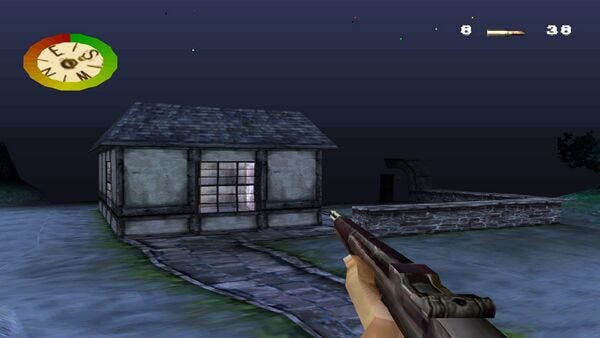
The first thing that any modern player will notice about Medal of Honor is that despite its low-quality graphics and occasional glitches, the game is far and away more fun than just about any corporate, mainstream war game of the current generation. There are no predatory loot boxes or $20 cosmetic skins; the whole game is focused on a narrative-based single-player campaign, and features full voice acting with a cinematic score written by future Oscar-winning composer Michael Giacchino. Playing Medal of Honor feels much more like a full experience than anything you will find in modern gaming, and the pure craft on display is immediately obvious.
![Medal of Honor walkthrough [PS1, 1999, HD]](https://substackcdn.com/image/fetch/$s_!_7w9!,f_auto,q_auto:good,fl_progressive:steep/https%3A%2F%2Fsubstack-post-media.s3.amazonaws.com%2Fpublic%2Fimages%2Fd96dcddf-f21a-4f27-a90f-9c437f572b8d_1280x720.jpeg "Medal of Honor walkthrough [PS1, 1999, HD]")
The game has an overwhelming sense of personality: it isn’t too serious, and calls to mind Where Eagles Dare (1968) or The Great Escape (1963), two of Spielberg’s favorite films. This pulpy feel almost works to smooth over the unrealistic graphics, as Spielberg does what he does best, allowing technology and narrative to combine, bringing out the best in both. The game’s AI feels genuinely alive and reactive, and certain tasks, like showing Nazi agents fake papers, make the whole game much more immersive than video games had ever been up to that point.
There is also an appreciation for history which future war games would completely lose. With Saving Private Ryan much too mature for children (and possibly Spielberg himself), Medal of Honor was intended to educate the youth about American history. Devoid of blood or bodily gore, Medal of Honor, like Band of Brothers after it, goes out of its way to honor American veterans, not make light of their sacrifice. Whether that is necessary in a video game is certainly up to personal opinion, but it wouldn’t be a Spielberg product without some hokey patriotism.
While I wouldn’t call Medal of Honor an outright masterpiece, it is hard to not feel Spielberg’s touch. I’ve played a fair few war games in my day, and the modern ones reek of corporate artifice; they may look superbly realistic on 4K screens, but there is no humanity in them, just violence. Much of Medal of Honor is mission-based, and along with the classic infiltrating of enemy camps or blowing up of Nazi weaponry, there are quieter moments where you must save a comrade, free prisoners, or just rescue civilians. Spielberg, ever the humanist, does not allow his game to become simply a killing machine.
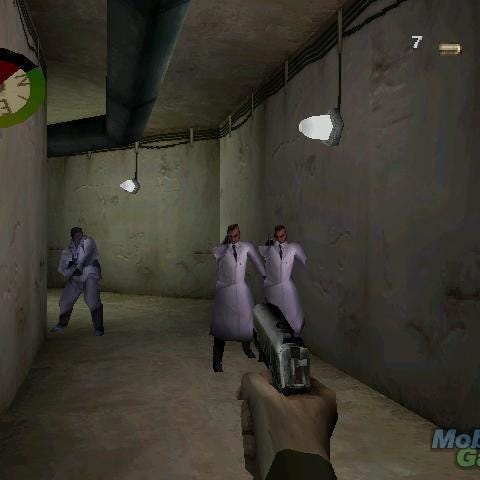
Of course, scholars of video game history will be quick to remind us that DreamWorks Interactive, which developed the first Medal of Honor, was bought by EA in 2000, after Spielberg lost interest in developing video games. In 2002, EA tapped a small development studio called 2015 Inc. to create Medal of Honor: Allied Assault, carrying on the vision of a WWII shooter Spielberg’s team had established. All the Medal of Honor games up to that point were huge leaps for the genre, but unhappy at EA, the core creative group at 2015 Inc. soon splintered off and formed Infinity Ward. Taking what they learned from the framework established under DreamWorks Interactive, this new development house would go on to create a small game called Call of Duty
Recently, Puck1 reported that Steven Spielberg pitched a vision for a Call of Duty film that he was, allegedly, quite excited about. Activision, spooked by Spielberg’s demands for full creative control over their precious billion-dollar military franchise, said no, selling the rights to David Ellison’s Paramount instead.
And so, the loop closes. After creating the modern framework of the historical shooter, Spielberg was slowly but surely pushed out of the very industry he birthed. Rather than thinking about whether he should make WWII video games, he only thought about if he could. This is a tragic, common story for our spry auteur, whose career is defined by great leaps in innovation quickly taken away from him, corrupted almost immediately by lesser minds. While he is not without agency — or resources — it seems that the pureness of his child-like soul often distorts the capitalist nature of his pursuits.
Critic Pauline Kael, in her review of Raiders of The Lost Ark, famously wrote that the film is akin to “being put through a Cuisinart — something has been done to [you], but not to [your] benefit.” Perhaps, as his dreams of making a COD movie were shattered, the never-stopping march of time ensuring he will never get a chance again, Spielberg finally understood what she meant all those years ago.
Signing off,
Max Bolen
The only person who has seen Amistad (1997) twice.
P.S.: Looking for more Max Bolen Official Content? Check out my new piece in wonderful Ministry of Pop Culture all about Daredevil: Born Again and the limits of corporate radicalism.
I do not pay for Puck, which is frequently just celebrity and executive level ass-kissing, but I am more than happy to cite them. I accessed this article for free. Belloni is fine.
I was very much looking forward to it, but they turned out to be some serious problems.
https://substack.com/@calvinjonescinematheory/note/p-201756288?r=8dbojf&utm_medium=ios&utm_source=notes-share-action