

Hello to all my wonderful World Outside Our Window Subscribers!
During the long hours I spend each week reading books, analyzing important works of art, and generally doing the work of a Great Thinker, I’ve developed an obsession with mid-to-late 19th Century American politics. The fight over slavery, Reconstruction, and the formation of a new, more mature country fascinates me, occupying what I’m told is a strange amount of space in my mind. Much to my surprise, though, the 100+ year old political battles I am so desperate to discuss do not seem to interest the Substack algorithm.
While I would be remiss to only cover attention grabbing topics, I am only One Max, so I must dedicate my limited time to pieces which may appeal to more than five people. A crazed late-night phone call with my girlfriend—me talking at her for 45 minutes about Garrisonian Thought, her begging to hang up—seemed to suggest that even the people I know in real life were uninterested. As I spent weeks searching for an excuse to write about Republican Party Factionalism in the 1870s, I began to simply accept that there was no good angle.
But then, in words which have never before been uttered: I was saved by Netflix. On Thursday, the streamer released Death By Lightning, a four-part miniseries set in 1880, starring Michael Shannon as President James Garfield and Matthew MacFadyen as Charles J. Guiteau.
The series traces Garfield’s unlikely rise to power and Guiteau’s parallel descent into madness. As all AP US History students surely remember, Guiteau’s decline eventually leads to him killing Garfield just a few short months after the 20th President’s inauguration. Finally, it seems mainstream culture has come around to what I have long known: the people crave prestige dramas about niche periods of American History.
Much to my delight, the series goes fairly deep into the politics of the era. The first episode focuses almost entirely on the 1880 Republican National Convention. As someone who once spent a weekend watching the 1988 DNC, I was excited to see a full hour devoted to the subject. But I’m also aware that most people don’t care about this strange American tradition, so it was a shock to see Netflix cover it so extensively.. It seems that in their drive to produce “content” for every niche, Netflix occasionally delivers something made for, generously, 50 people. Rarely do one of these niche shows feel genuinely good, but Death By Lightning stands out as truly well-made prestige television, rising well above a simple period piece, becoming a fascinating, and hilarious, satire.
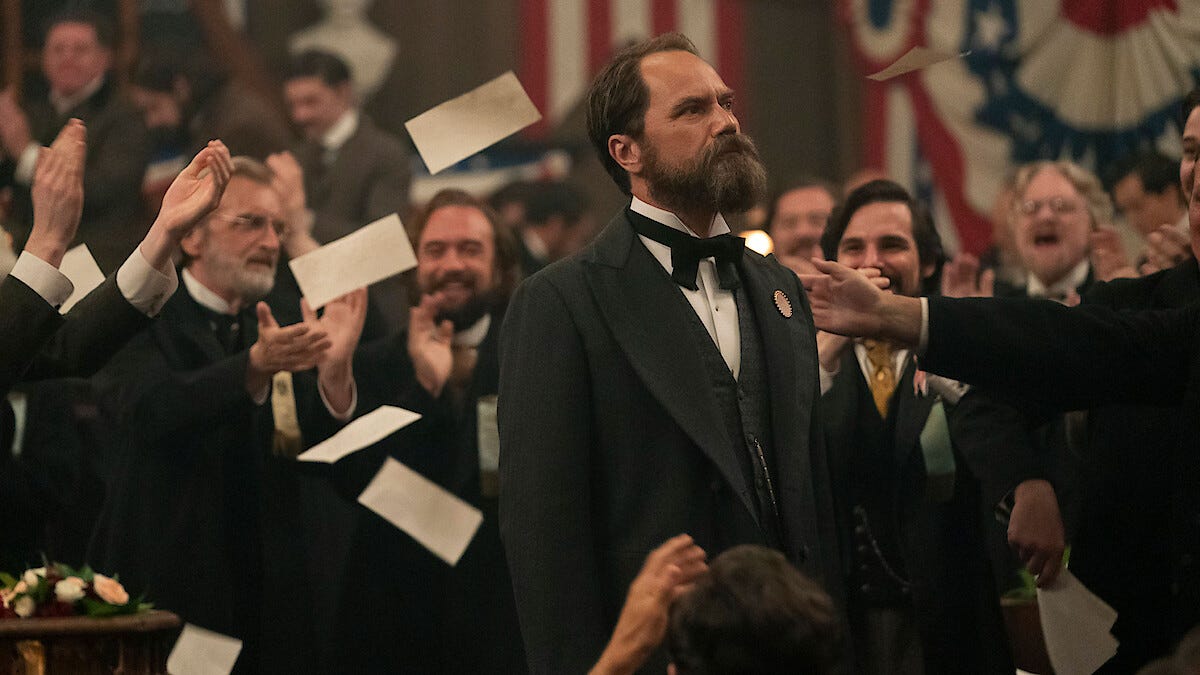
Death By Lightning works so well because the show is deliberately anachronistic in its dialogue and sensibility, making 1880s politics feel immediate, relatable, and funny. The 1880 RNC fight that takes up much of the first episode is, in essence, a battle over public corruption, or what was then known as The Spoils System. For most of the 1800s the President would appoint only top donors and party loyalists to federal positions. These weren’t ceremonial gigs—a local Postmaster wielded real power, and controlling appointments meant controlling politics. One of course can’t help but think of the modern-day Republican Party’s fondness for corruption, with Trump pardoning anyone who has shaken his hand. This comparison is made easier with the modern dialogue, as the 1880 fight looks and sounds almost identical to those of today. Trump’s public desire to return to Gilded Age politics also makes similarities abundantly clear.
But, unlike our present moment, Death By Lightning starts at a time when certain parts of the GOP were getting sick of the corruption and favoritism and were actually planning a party coup. The Half-Breeds, as they were called, sought to reform the Civil Service into a merit-based system. Led by Maine Senator James Blaine (Bradley Whitford, doing the exact same performance he’s been doing for decades), they show up to the 1880 Convention determined to block former President Grant from getting the Presidential nomination once more. I am a huge defender of Grant, putting my body on the line for him in many online wars, but it can’t be denied that his penchant for corruption tore his Presidency apart.
Despite hailing from Maine—a place so irrelevant it only became a state as part of a doomed compromise over slavery—Blaine manages to take on The Stalwarts and their leader from New York (the only Real State), Senator Roscoe Conkling (Shea Whigham). Best known for his wanton corruption and fantastic name, Conkling is shown as supporting the spoils system for one reason: he wants control over the Port of New York and who would be appointed the next Collector. Before the advent of income tax, tariffs and fees levied on shipped goods accounted for most of the Government’s balance sheet. Once again, similarities to our present moment abound, as a crook from New York desperately screams about tariff revenue and the need to control it.
After 35 deadlocked ballots, the 1880 Convention finally picks a compromise candidate: James Garfield, who’s not a Stalwart nor a Half-Breed, and doesn’t really want to be there in the first place. Outside the Convention Hall stands Charles Guiteau, who up till this point has been shown as a well-meaning buffoon trying his best in a tough world. Ostensibly there to launch his new paper, The Daily Theocrat, Guiteau spots Garfield departing and excitedly runs up to shake his hand. Guiteau, hilariously, pretends to greatly love this random congressman from Ohio. Who among us hasn’t had to pretend to like someone from Ohio?
Inspired by this handshake, Guiteau decides to help the campaign by writing a speech in support of Garfield. The show does leave out my favorite detail: Guiteau literally just took a speech he’d already written for Grant, crossed out “Grant,” scribbled in “Garfield,” and called it done. Historians contend the speech was delivered at most twice, and the show doesn’t depict either time, but it’s enough to convince Guiteau that he personally won Garfield the presidency.
At this point, Death By Lightning turns away from the political gamesmanship of the Convention and Campaign, and begins to focus squarely on Guiteau. Something I love about grand period pieces is our weirdest, most committed actors getting the chance to portray real freaks. Guiteau is one of history’s greatest freaks, and MacFadyen makes a meal out of every word spoken, with every small tick of his face or glance taking on a life of their own. There’s a particularly memorable moment wherein Guiteau is trying to sneak into the Oval Office and is stopped by a very old White House Butler. He picks up a stack of papers and throws them at the Butler, before screaming “Eat Shit!” and running away.
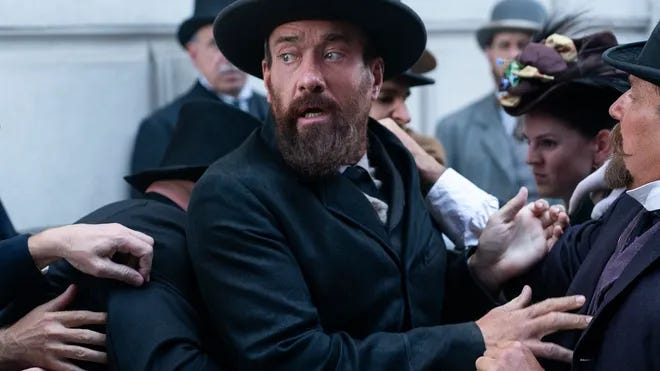
Guiteau comfortably fits into an archetype which is becoming unfortunately familiar: the sad, isolated, and disillusioned man left behind by the political process. Death By Lightning satirizes these men with MacFadyen’s increasingly deranged performance, and manages to humanize the person below while never excusing his twisted ideology. Not having the modern option of posting racist memes online and making AI Troll Videos, Charles sets out to kill the President after it is made clear he has no job waiting at The White House. At first simply revenge, Guiteau soon convinces himself of a deluded quest given to him by God to restore the soul of the GOP and put Stalwart Vice President Chester Arthur in charge. It is impossible not to think of the modern-day political violence plaguing our nation, carried out by deluded incels or ugly Groypers, who assume that their act of killing will lead to political change. This never works out, though, and it doesn’t for Guiteau either. Once President, Chester Arthur mostly honors Garfield’s wishes, keeping the reformist cabinet and passing vast Civil Service reform.
The show is fantastic, especially the two leads. MacFadyen, who has gotten quite good at playing slightly sympathetic losers, perfectly captures Guiteau’s delusions of grandeur, as he morphs from a quiet and struggling man on the fringes into a violent and sadistic psychopath. By contrast, Shannon delivers a reserved performance, portraying the short-lived President with honor and principle. Whereas MacFadyen’s performance is almost Joker-like in its subtle yet intimidating menace, Shannon’s portrayal is akin to that of Martin Sheen’s President Bartlet, with his grandiose speeches and moralistic views on the Presidency. Considering the Venn Diagram of West Wing fans and Death By Lightning viewers is a circle, this comparison is likely intentional.
Watch Death By Lightning. Then email me, because I have so much more to say and if I have to keep these thoughts about 1880s patronage politics to myself any longer, I will simply perish. And then who will send you a weekly email about topics you never dreamed of caring about?
Signing off,
Max Bolen
Putting the history minor to work.