

Hello to all my Wonderful World Outside Our Window subscribers,
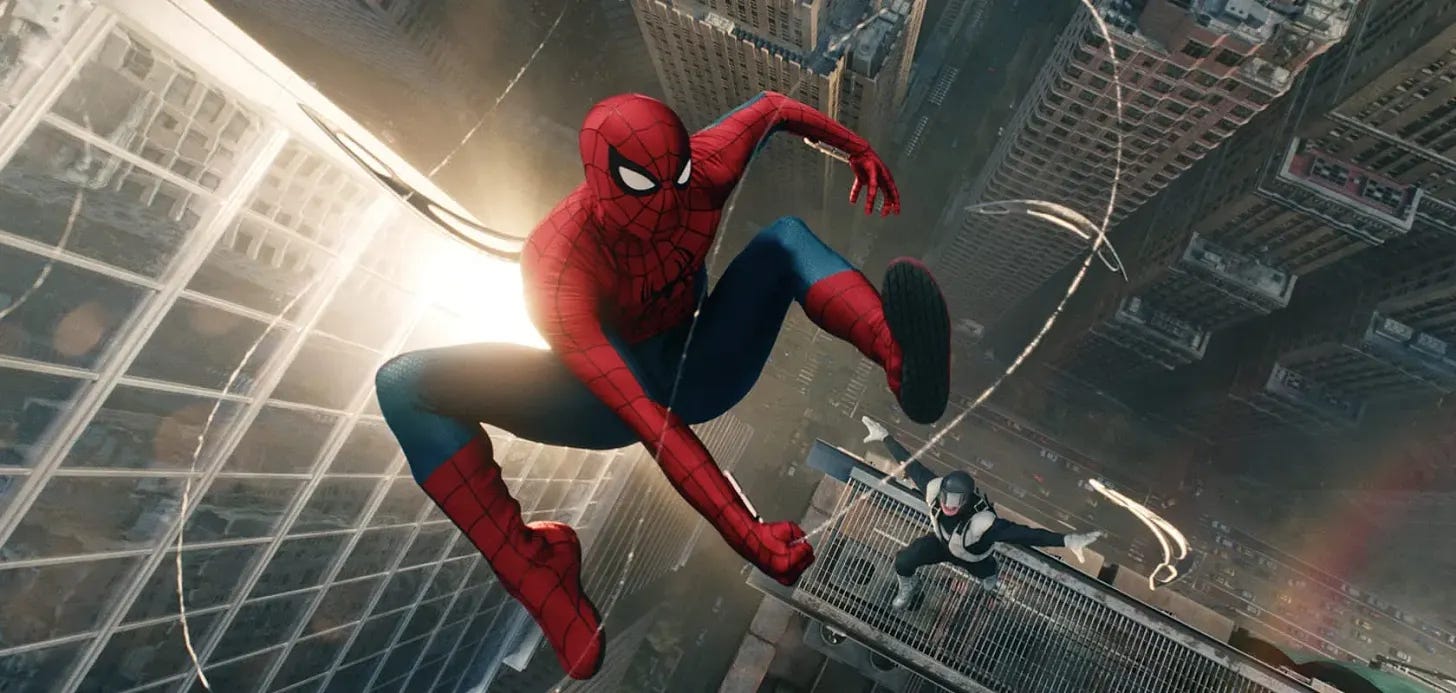
As I’m sure you know, last week saw the release of Marvel Studios’ Spider-Man: Brand New Day. Despite my carefully constructed persona as a Serious Thinker and watcher of Important Cinema, seeing the trailer — which featured Spider-Man beating up the Hulk — was enough to convince me that I simply had to see the film. I’m happy to report it was exactly as mediocre as I anticipated, and in a welcome surprise, it also continued Marvel’s tried-and-true practice of producing new and innovative military propaganda, this time by depicting Peter Parker as distinctly to the right of Peter Thiel.
The movie is certainly a marked improvement over the last few Feige-generated Spider-Man flicks, but I must admit that the ravenous reaction to it has caught me a bit off guard. On the surface, all the flaws that made “Marvel Fatigue” the talk of the town are still front and center in this latest film. It has multiple exhausting crossovers, its bloated runtime drags ad nauseam, and it fundamentally looks no better than a Disney+ show. Yet, in less than a week, Brand New Day shattered records, making over a billion dollars at the box office whilst garnering some of the most glowing reviews Marvel has received in years.
The natural question is, if audiences are supposedly exhausted by the Marvel formula, why did they turn out in droves for a movie that still heavily uses it? I think it is because the film employs a masterful use of semiotics that previous MCU films never bothered with. Brand New Day isn’t actually a radically different movie than anything Marvel has made, but by weaponizing the visual shorthand of a “classic” Spider-Man, the film can trick our subconscious into feeling an unearned emotional response. This allows the film to escape the pitfalls of the modern MCU without having to actually do anything different.
Functioning as a soft reboot, Brand New Day explicitly jumps the timeline forward five years, catching Peter up with the rest of the MCU and finding him alone, depressed, and broke. Stopping just short of winking at the camera, an extended opening montage screams as loudly as possible that this is the old Spider-Man you know and love. Instead of doing the “hard” narrative work of maturing Holland’s Parker, the film simply co-opts the world-famous iconography of Spider-Man to fake it, something easily proven by the opening montage’s decision to (painfully!) recreate a few iconic Spider-Man covers.
Director Destin Daniel Cretton is using the visual language of superheroes, and the knowledge that everyone who’s anyone has seen a Spider-Man movie, to his advantage. He puts Holland in a hand-sewn red-and-blue suit, tosses him into a shiity apartment, and a few scenes later lets him finally speak in a “New York” accent, and just like that he’s got all the signifiers of a Classic Spider-Man. Don’t worry about the fact that the suit is still packed with tech, the crappy apartment has an entire science lab, and the New York accent is unmistakably Brooklyn, not Queens. Spider-Man is such an iconic character that a few hints are all the Cretton needs to trick us into thinking we are watching something much better.
The most egregious example of this is Peter suddenly developing organic webbing, something the Tobey Maquire films are quite famous for inventing. The film uses this to trick our subconscious into feeling like Holland’s Peter has grown up. The climatic battle at the end, wherein Peter’s embrace of the organic webbing allows him to reach the “true power” he always had, is a very unsubtle way to signal to the audience that those old Sam Raimi Spider-Man movies they remember being better are coming back. Holland literally has to learn how to be Tobey Maquire’s Spider-Man in order to save the day. It is frankly absurd.
This absurdity extends well past the visual language of the film, and is in fact baked into the narrative. The emotional “stakes” of Brand New Day hinge on the audience’s preexisting attachment to Peter and MJ’s relationship. Ignoring the fact that Zendaya wasn’t even confirmed to be MJ until the last scene of Homecoming, the two didn’t get together until the back half of Far From Home, and they were separated again by the end of No Way Home, Brand New Day spends roughly thirty minutes of its runtime framing their prior relationship as one of deep intimacy and maturity. In the theater, this almost makes sense: it’s Peter and MJ, so of course they love each other (magic spells notwithstanding). Audiences have seen a million versions of this story, why should they question this one?
But if we zoom out to look at the film’s larger thematic message, a glaring contradiction emerges. Brand New Day is, at its core, a movie about self-reliance and moving on. The text wants to tell a story about Peter Parker finally stepping out of the shadows of mentors, billionaires, and gods to find his own independent identity. The film’s script insists that Peter is moving on, but its semiotics trap him in a perpetual loop of looking backward. As an audience member, we are simply forced to maintain a certain level of cognitive dissonance in order to enjoy the film. The meta-textual admission by Feige and Holland that the previous MCU Spider-Man movies were not really all that good flys in the face of Brand New Day’s incredibly maudlin emotional core.
I do think Brand New Day offers some clues as to how Marvel is navigating its new, heavily demoted status in culture. They are clearly acutely aware that the era of shiny, government-approved superheroes solving big-picture problems feels increasingly out of touch. Audiences are currently craving a street-level, working-class struggle; we want heroes who worry about making rent as much as fighting villains, and characters who help their neighbors rather than flying to space. But a multi-billion dollar corporate behemoth will not (and really, cannot) show working-class authenticity. They are more than happy, though, to mass-produce the signifiers of it.
Knowing they were in a rut, Marvel took advantage of the organic desire for a grounded hero, without bothering to do the work of writing one. This is quite craven considering he already exists, but one billion dollars later, it seems like they will get the last laugh.
Signing off,
Max Bolen
Does in fact own one of the comic covers that was poorly recreated in this film
Anthony Mackie Captain America meme: "He's out of line, but he's right."
I suspect the "MCU is back!" narrative is premature and "Doomsday" will demonstrate that. People just really like Spiderman and always have. I predict a return to the early 2000s, where superhero films are still very present, but not all consuming.
this makes lots of same arguments i attempted to articulate in my review this am but better. I’m still waiting for Feige and co. to realize Spider-Man is a brand onto himself and he doesn’t need all this extra stuff around him.