James Gunn Was Only Hired To Be Fired
It turns out the Gunn was empty after all :(

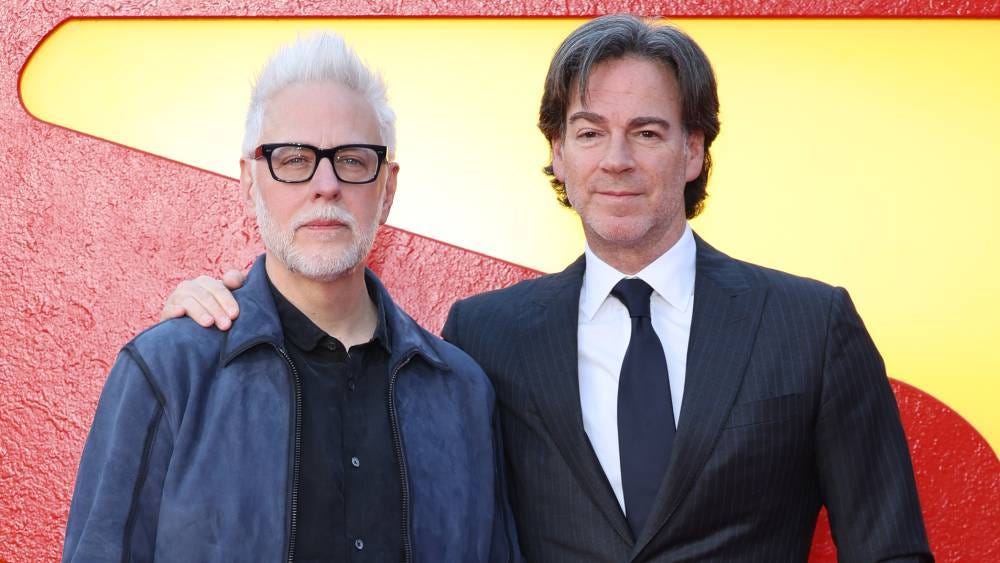
Hello to all my Wonderful World Outside Our Window subscribers,
On Monday, news broke that James Gunn and Peter Safran, the co-CEOs of Warner Bros.’ nascent DC Studios, were out. Hired only four years ago to restart a franchise that never quite got off the ground, they managed to release just three films and a few television shows before being unceremoniously shown the door by Warner Bros.’ new parent company, Skydance. (The official line is that they’re “stepping down.” I’m sure.) Marvel veteran Jeremy Latcham has been tapped to take over as president and chief creative officer, reporting to Dana Goldberg and Josh Greenstein, the Paramount execs who now oversee Warner Bros. too. Man of Tomorrow, Gunn’s sequel to 2025’s Superman, has wrapped production and is (presumably?) still slated for release next summer, which means Skydance will have to spend considerable time and money promoting a movie by the man it just let go. This is very funny.
Most of the Hollywood trades are covering this like a huge surprise, but here at The World Outside Our Window, I refuse to be a credulous stenographer for whichever exec leaked me a story. No one at Warner Bros. over the past four years was under any illusion that their jobs were safe, or mattered at all, Gunn included. That was obvious with even a cursory analysis of their work.
After David “The Zaz” Zaslav took over the newly merged Warner Bros. Discovery in 2022, he spent a year cutting expenses and paying off debt. From cancelling completed films to get tax refunds to scraping entire streaming services like CNN+, Zaz was not subtle about his agenda. Then, he spent two years fattening up Warner Bros. with all sorts of expensive projects that signaled prestige and value, freed from the burden of running a sustainable business because everyone knew he was planning on scrapping it for parts from the very start. In 2025, Warner Bros. Discovery announced it would split in two, and everyone just pretended that was the actual plan, before feigning surprise when a bidding war erupted. They had one mandate, and only one mandate: juice up the stock until someone buys the company. Long-term was a problem for the next owner.
Consider the tenure of Mike De Luca and Pam Abdy, Warner Bros. Discovery’s chief film executives. After being fired from MGM (due to a different merger!), Zaz quickly scooped them up, and seemingly told them to do whatever they wanted. We got a movie like Sinners, that was green-lit despite director Ryan Coogler’s (awesome, inspiring, honorable) demand for full ownership, a huge budget for Paul Thomas Anderson’s One Battle After Another, and the full investment in Digger a film that will apparently lose so much money Skydance executives were genuinely dumbfounded when they walked through the doors on day 1 and read the books. It doesn’t take a genius to get that De Luca and Abdy were happy to give Coogler the rights to Sinners because, well, they weren’t gonna be there to use them anyways. Who cares if OBAA or Digger lost money, the movies were cool and their job was ending soon anyways.
In Season 7 of 30 Rock, Alec Baldwin’s Jack spends much of his time trying to tank NBC. He unveils a shockingly bad fall lineup of garbage television in order to force his parent company, the unserious and (shudders) Philadelphia-based Kabletown, to sell the network, ideally to Paas, the Easter egg dye company, which he considers a more serious owner. (In typical 30 Rock fashion, the plan keeps getting flipped upside down when the garbage turns out to be incredibly popular.) The key to understanding Warner Bros. (and much of our culture) is assuming 30 Rock was just a bit early. Zaz was basically running Jack’s plan in reverse. Instead of tanking the value, he green-lit a caravan of expensive toys until he could sell the company and literally fly off on his golden parachute.1
The thinking behind hiring James Gunn becomes very clear in this context. By most accounts Zaz personally liked him, thought his vision for making movies about weird characters sounded fun, and ultimately just needed a shiny new DC Universe to show the market. I’d be lying if I said I didn’t roll my eyes when Gunn first announced plans for this universe in 2023. From a guarantee that no script would go into production until it was good (this is Hollywood, baby, c’mon), to a series of asinine rules about what was and wasn’t “canon,” nothing about Gunn’s rhetoric, actions, or greenlit projects suggested a serious producer building out a long term business. This is a man who wanted to make a movie about The Authority before Batman. My theory is that the DCU was never built to last, but rather shown to the market, sort of like a staged home. I suspect Gunn knew this, so why not announce some weird shit?
This also explains why, and I hate to give him any credit, Ellison’s decision makes a whole lot of sense. Gunn was the perfect hire for a company that wanted to be sold (he’s well respected and makes headlines) but a horrible fit for just about anyone else. I hate to talk box office, but the cold hard truth is that Superman made an underwhelming $618.7 million worldwide on a $225 million budget (plus more than $100 million in marketing), and had limited cultural resonance. Supergirl grossed $126 million on a $170 million budget, got bad reviews, and was, frankly, embarrassing. DC’s ill-advised foray into horror resulted in Clayface, which cost around $40 million, and grossed $109 million so far, so a modest profit, but was altogether a waste of time: people go to DC for superheroes, and trying to reheat Blumhouse nachos with a Batman villain is, well, odd, especially when its only your third film.
The slate was filled with niche, nerdy, and totally unfinished projects, none of which anyone was particularly excited about, let alone aware of. Gunn’s boisterous personality and highly specific taste does not make sense under the new structure of Warner Bros., where the head of DC no longer reports to the CEO like Gunn did but rather to Goldberg and Greenstein. Even Gunn admitted in his farewell post that he disliked the “at-times corporate nature of the job,” and his statement seems to carry a sense of relief. By any standard metric of success, Gunn’s time at DC was quite mediocre, and he was only allowed to spend all this money (and lose it) in the first place because the mods were asleep, and no one was looking.
There are of course those who think Gunn was fired for purely political reasons, and I’m not entirely allergic to those arguments. It’s true that the new DC Boss is seemingly conservative in his sensibilities, and is significantly more religious than your average Hollywood power-player. It is also certainly true that Ellison is making a concerted effort to prove his wacky hypothesis that he can make a lot of money by reaching the non-existent corners of America that are too conservative for Hollywood, but James Gunn was not exactly a bleeding-heart2, and my guess is the new boss will just be easier to work with. He probably doesn’t have too many opinions, won’t spend hours every day arguing with fans online, and one assumes he will run the studio less like an important universe full of storied history and more like what DC really is: a product that sells toys.
While superheroes may feel like the closest thing America has to a national mythology, they have never been more than intellectual property to be bought and sold. In 1938, Jerry Siegel and Joe Shuster sold the rights to Superman for $130, essentially sealing the fate of an entire genre before it began. It’s certainly sad for all the, writers, artists, and dedicated creatives this will affect, but as Siegel and Shuster could tell you, they have never been the ones calling the shots.
Though I have my issues with Gunn’s films, he has a deep love for filmmaking, is quite good at it, and clearly allowed his employees to infuse their work with much more passion than any other studio exec. The untimely demise of his universe is certainly a loss for those of us who feel Hollywood filmmaking could be something more than it is, and I’d still rather live in a world with his weird choices than with Ellison’s risk-free ones. I just think none of this is particularly surprising, and feel that us film fans often make the mistake of reacting too emotionally to routine business shakeups. Hollywood is more monopolistic than ever, and remaining vigilant about what these executives truly intend feels important. Gunn was simply never built to last, and he knew it.
But hey, maybe in five years, when Ellison needs to sell off DC to pay down the debt from this deal (and keep his Gulf sovereign wealth fund investors happy), someone will make a good Justice League movie. I’m sure we just need one more merger to make it happen.
Signing off,
Max Bolen
Used to be something of a Gunn-fanboy if you can believe it.
Jack likely would have found Ellison’s proud anti-intellectual bent embarrassing, even if he agreed on the merits.
He was a big Andrew Yang guy in 2020, if that means anything to you.
Discussion about this post